Buying
What AI Search Tells Buyers About Safety Vendors, and How to Check It
We asked Google, ChatGPT, Bing Copilot and Claude the questions safety buyers ask. Their shortlists differ, and many answers rest on pages vendors wrote about rivals.
By LIPAI WANG · Updated · 10 min read · 8 sources · 1 figure
More safety buyers now start a vendor search by asking an AI tool. To see what they get back, we asked the same questions in Google (normal results, AI Overviews and AI Mode), ChatGPT, Bing's Copilot Search and Claude on October 2, 2026, and recorded which vendors each named and which pages each cited. The answers were often useful and often lopsided. Much of what the tools said came from pages vendors wrote about themselves and about each other.
This is one run per question per tool, in one browser, on one day. AI answers change from run to run, and Perplexity required an account, so it is not included. Read the results as a picture of how these answers are put together, not as a ranking of vendors.
What did we ask?
Six questions a buyer might type: the best AI video analytics software for workplace safety; AI safety monitoring that works with existing CCTV in a warehouse; forklift and pedestrian near-miss detection with cameras; AI video safety analytics for ports in the UK; a three-way comparison of Protex AI, Intenseye and Voxel; and how much the software costs. We also searched for reviews of several vendors.
ChatGPT was used in a temporary chat with memory and personalization switched off, and Claude in an incognito chat, so earlier conversations could not shape the answers. Google's AI Mode was used while signed in and offered a version without personalization, so its answer may reflect the account.
Who did the engines recommend?
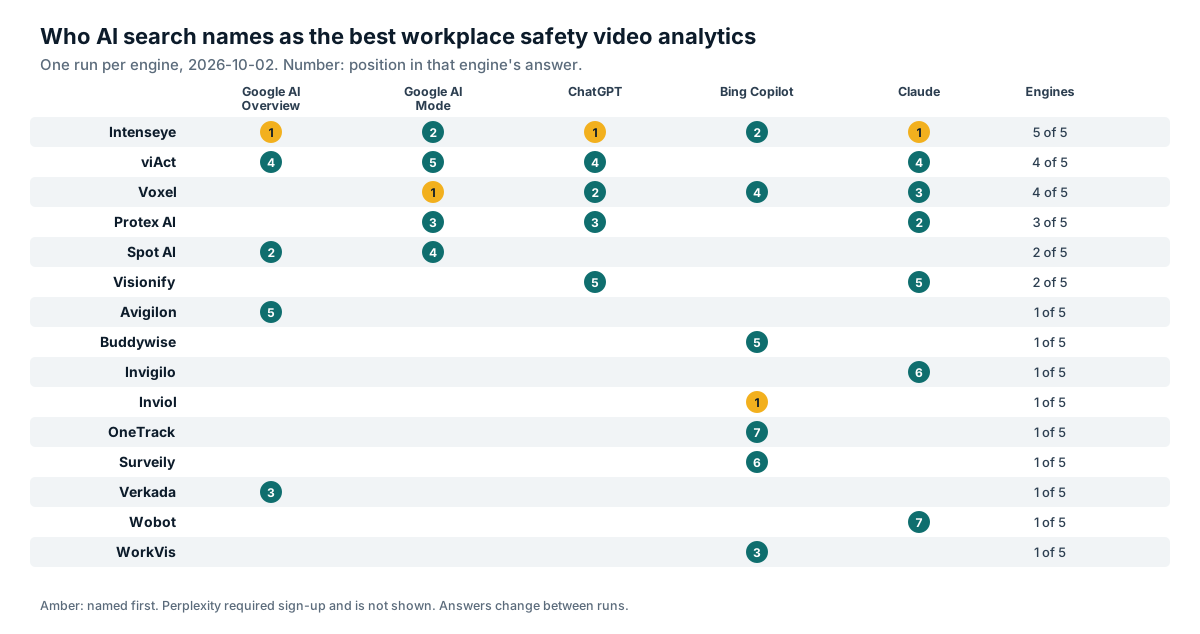
Intenseye was the only vendor all five engines named, and three of them put it first. Voxel and viAct appeared in four answers and Protex AI in three. After that the lists diverged. Bing's Copilot put a vendor first that no other engine mentioned, and named four more that appeared nowhere else. Google's AI Overview included general video security platforms such as Verkada and Avigilon alongside safety specialists.
None of this tells you which product is best for your site. It tells you that the shortlist you start with depends on which tool you ask.
Where did the answers come from?
Vendor-written "best of" lists
For the broad "best software" question, seven of Google's top eight normal results were vendor pages or lists published by vendors, several of which rank the publisher first. Bing's Copilot answer rested mostly on two such lists [4][5], and Bing's normal results were dominated by sites that publish generic "Top 10" rankings for every software category. We did not find an independent buyer's guide in the top results on either engine.
Comparisons written by competitors
When we asked for a comparison of Protex AI, Intenseye and Voxel, Voxel's own comparison pages held Google's top three positions and were the only source cited in Google's AI Overview [2]. On Bing, Voxel's pages came first and second, followed by a comparison published by another vendor, YAFE [3]. Bing's Copilot then described Intenseye as cloud-centric and likely to need more bandwidth, citing that competitor's page.
A vendor's comparison page can be accurate. It is still written by one side, and in these answers it decided how the other two vendors were described. Claude was the only tool that warned, unprompted, that most "best of" rankings are written by vendors that rank themselves first. Even so, several of its vendor descriptions were sourced from one vendor's comparison pages.
Authorities for general questions
For the UK ports question, ChatGPT named almost no vendors. It cited Port Skills and Safety injury figures, UK government port statistics and the Information Commissioner's Office guidance on video surveillance. Google's AI Overview for the same question named one UK specialist, citing a technology company's social media post rather than the specialist's own site. Questions about a sector or a regulation tend to pull in official sources; questions about "the best tool" pull in marketing.
What did they say about price?
This is where the answers disagreed most. Google's AI Overview and Bing's Copilot both said AI video analytics costs about $3 to $15 per camera per month. Their sources were general video security vendors, not workplace safety platforms.
ChatGPT gave a figure about ten times higher, from a better source. Protex AI's listing on AWS Marketplace prices a 12-month contract at $45,000 per site, covering the edge computing device, setup and onboarding, plus $2,500 per camera, with discounts for 24- and 36-month terms [1]. By that listing, one site with 20 cameras would cost $95,000 for the first year before any discount. Intenseye publishes a pricing page of its own [8], and most other vendors quote on request.
The lesson is not that one number is right. A per-camera analytics add-on for a security system and a managed safety platform with on-site hardware and onboarding are different products. Ask every vendor for a written quote that separates site fees, camera fees, hardware, implementation and support, and compare like with like.
What did they say about reviews?
Review summaries were built on thin evidence. For Protex AI, Google's AI Overview reported an average of about 4.8 out of 5, citing the AWS Marketplace listing, where that average came from four reviews. Voxel's G2 page showed 4.6 from seven reviews [6]. For Intenseye, the AI Overview combined product reviews from G2 with employee reviews of the company from Glassdoor, which measure different things.
Two other patterns stood out. A competitor's "Voxel review" page ranked second for a search on Voxel reviews [7]. And for RoboK, a smaller UK vendor, there were no independent reviews to find, and the results filled up with unrelated products that share part of its name.
How should buyers use AI search?
AI tools are a fast way to find names. They are not yet a reliable way to compare them. A practical routine:
- Ask more than one tool. Combine the names, then look for what is missing. If you only ask one engine, its sources decide your shortlist.
- Open every cited source and note who wrote it. A vendor's own page, a vendor's list of "top platforms" and a competitor's comparison page are all marketing. Give more weight to regulators, independent analysts, customers and your own tests.
- Ignore AI price ranges. Ask for written quotes in the same format from every vendor.
- Check review counts and what is being reviewed. Four reviews is an anecdote. An employer rating is not a product rating.
- Ask references, not the internet. Speak to two customers at sites like yours, and ask what did not work.
- Run the same pilot for every finalist. The buying chapter sets out acceptance criteria and a pilot plan, and our public evidence check lists the documents to request.
Limitations
We ran each question once in each tool, in one desktop browser with US English settings. AI answers vary between runs, accounts, locations and dates. Google's AI Mode answer may have been personalized. Perplexity is missing because it required an account. We recorded what the tools said and cited; we did not test the products or verify every claim in the answers. The figures quoted from AWS Marketplace and G2 were checked on the day; vendors can change listings at any time.
Summary
On October 2, 2026, five AI search tools gave five different shortlists for the same buyer question, and many of their answers were assembled from vendor-written lists and from comparison pages one vendor wrote about its rivals. Prices varied by about ten times depending on the source, and review summaries rested on a handful of reviews. Use AI search to collect names, then verify everything at the source.
Frequently asked questions
+Can I use ChatGPT or Google's AI answers to build a vendor shortlist?
As a starting point, yes. Open every cited source and note who wrote it. In our test, several answers rested on lists written by vendors that rank themselves first, so the shortlist reflected their marketing as much as the market.
+Why did different AI tools recommend different vendors?
Each engine searches a different index and favors different source types. Bing's answer leaned on two vendor-written lists, Google's AI Mode leaned on one vendor's own pages, and ChatGPT cited vendor websites directly.
+Are the prices AI tools quote reliable?
Only as reliable as the source. Two engines quoted per-camera prices from general video security vendors that do not sell safety platforms. Ask each vendor for a written quote that separates site, camera, hardware and service fees.
Related reading
Sources
- [1]AWS Marketplace: Protex AI listing and pricing
- [2]Voxel: Intenseye vs Protex AI vs Spot AI
- [3]YAFE: AI safety software comparison
- [4]Riodatos: 11 CCTV AI safety platforms that turn cameras into workplace safety systems
- [5]Observia: AI for workplace safety, 13 behavior-based intelligence platforms compared
- [6]G2: Voxel reviews
- [7]Spot AI: Voxel review
- [8]Intenseye: Pricing
New chapters and updates, once a month
One email when we publish or update guidance. No vendor promotions. Unsubscribe any time.