Buying
What AI Video Safety Vendors Publish for Buyers: A Public Evidence Check
We checked the public websites of eight AI video safety vendors for security pages, data agreements, pricing, case studies and accuracy methods. Here is what we found.
By LIPAI WANG · Updated · 9 min read · 13 sources · 1 figure
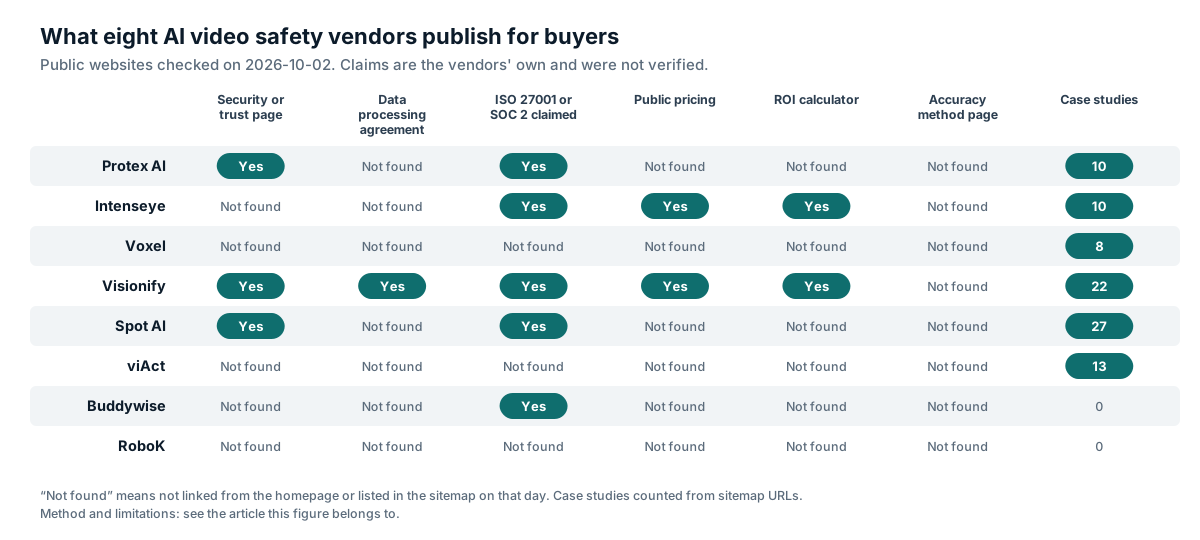
Before a vendor ever joins a call, its website is already answering, or not answering, the questions a careful buyer will ask. We checked the public websites of eight AI video safety vendors on October 2, 2026 for the evidence buyers most often need early: security documentation, data processing terms, certifications, pricing, case studies and any explanation of how detection accuracy is measured. The short answer is that public evidence is uneven, and one item, an accuracy method, was missing everywhere.
This is a snapshot of public websites, not an assessment of products. A vendor that publishes little may still answer every question well in a sales process. The point is to show what you can learn before that process starts, and what you will need to ask for.
What did we check, and how?
We looked at Protex AI, Intenseye, Voxel, Visionify, Spot AI, viAct, Buddywise and RoboK, the specialist AI video safety vendors and one broader video platform covered in this guide. For each site we read the homepage, the XML sitemap and the pages they link to, and recorded whether we could find:
- a security or trust page;
- a published data processing agreement (DPA);
- a claim of ISO 27001 certification or a SOC 2 report;
- a public pricing page and an ROI calculator;
- case studies or customer stories;
- a page explaining how detection accuracy is measured or validated.
"Not found" means the page was not linked from the homepage or listed in the sitemap on that day. Sitemaps can be incomplete, so a vendor may publish something we missed. Certification statements are the vendors' own claims; we did not verify certificates or reports. Spot AI sells a general video security platform as well as safety features, so its numbers reflect a broader business.
What did we find?
No vendor explains how accuracy is measured
None of the eight sites had a page describing how detection accuracy is defined, tested or validated. Several publish outcome figures in case studies, such as reductions in observed risks, but without a stated method you cannot tell whether a figure reflects precision, recall, a change in behavior or a change in how events were counted. Chapter 4 of the guide explains why precision and recall are different failures and why benchmark scores rarely transfer between sites.
Security documentation varies widely
Protex AI publishes a set of privacy and security pages [1]. Visionify publishes a security page and a full DPA [4][5], and Spot AI has a security page [7]. viAct has a page explaining GDPR in construction technology, which is useful background but not a contractual DPA [13], and Buddywise lists its sub-processors without a DPA page we could find [11]. Intenseye, Voxel and RoboK had no dedicated security or trust page linked from their homepage or sitemap.
Video of workers is personal data in most jurisdictions, so the DPA, retention terms and sub-processor list will matter in any European deployment. If they are not public, request them before the pilot, not at contract stage.
Certification claims need checking
Protex AI, Visionify and Buddywise claim ISO 27001 on their sites [1][4][10]. Intenseye, Visionify and Spot AI claim a SOC 2 Type II report [2][4][7]. RoboK states Cyber Essentials, a UK baseline scheme [12]. Voxel and viAct made no certification claim on the pages we checked.
A claim on a marketing page tells you what to ask for. For ISO 27001, request the certificate with its scope and expiry date. For SOC 2, request the most recent report under NDA and check which systems it covers and the period it tested.
Pricing is rarely public
Intenseye and Visionify publish pricing pages and ROI calculators [2][3][6]. The other six do not show prices. That is normal for enterprise software, but it means you need a total cost of ownership model of your own. Chapter 14 covers what to include.
ROI calculators are useful for structuring a business case. Their default assumptions are the vendor's, so replace them with your own incident rates, costs and the effect size you can defend.
Case studies are plentiful, but they are the vendor's selection
Spot AI, Visionify, viAct, Protex AI, Intenseye and Voxel list between 8 and 27 case studies each. Buddywise and RoboK list none in their sitemaps. Case studies show the sectors a vendor knows and the problems customers chose to talk about. They are not a random sample. Ask for references at sites like yours, and ask those references what did not work.
Comparison pages are marketing
Voxel publishes 77 pages comparing itself with named rivals or listing "alternatives", such as a three-way comparison with Arvist and Intenseye [8]. Spot AI publishes 166 comparison pages, mostly against general video security vendors [9]. Visionify has two. The other five have none.
These pages can help you build a list of criteria, because they show what each vendor thinks matters. They are written by one side, so they are not a substitute for running candidates on the same cameras with the same acceptance criteria.
How should buyers use this?
Missing public evidence is not a reason to drop a vendor. It is a list of questions to ask early. A practical approach:
- Request the documents up front. Security overview, DPA, sub-processor list, retention policy, and the certificate or SOC 2 report with dates and scope.
- Ask for the accuracy method in writing. How a true positive is defined for each event type, how reviewers label events, and how precision and recall will be calculated in your pilot.
- Build your own cost model. Use vendor calculators for structure only.
- Treat case studies and comparison pages as leads, not evidence. Speak to reference customers in your sector and test on your own sites.
- Put the same questions to every vendor. The RFP section of the buying chapter has a full list.
A request list you can send to every vendor
| Request | Why it matters | What a good answer includes |
|---|---|---|
| Security overview | Shows how video and accounts are protected | Hosting location, encryption, access controls, incident process |
| Certificate or SOC 2 report | Confirms the claim on the website | Scope, issuing body or auditor, dates |
| Data processing agreement and sub-processors | Required for worker video in most of Europe | Roles, retention, deletion, transfer terms |
| Accuracy method for each event type | Turns outcome claims into something testable | Labeling rules, precision and recall, sample sizes |
| Two references at similar sites | Tests case study claims | Same sector, similar camera estate, permission to ask what failed |
Limitations
This check covers public websites on a single day. Vendors update their sites often, and some share security and accuracy documentation only under NDA. Counts come from sitemaps and homepage links, which can be incomplete. We did not test products, verify certifications or contact vendors. If a vendor believes something is missing or wrong, it can send a correction through our contact page, and we will recheck and note any change on this page.
Summary
On October 2, 2026, public evidence from eight AI video safety vendors ranged from a full set of security, data protection and pricing pages to a homepage and a privacy policy. No vendor explained how detection accuracy is measured. Use what is public to save time, request what is not, and make the accuracy method part of the pilot agreement before any camera goes live.
Frequently asked questions
+Does a vendor without a public security page have weaker security?
Not necessarily. Many enterprise vendors share security documentation only under NDA. A public page saves time early; its absence just means you request the documents directly, with dates and scope.
+Should I trust a vendor's comparison page about its competitors?
Read it as marketing. It shows how the vendor wants to be compared, which can be useful for building your criteria, but test the claims yourself on your own cameras.
+Why does no vendor publish an accuracy method?
Accuracy depends heavily on the site, camera placement and rule settings, so vendors tend to share results case by case. That makes it more important to agree a measurement method for your pilot in writing.
Related reading
- Guide · Chapter 4How AI Video Safety Analytics Works
- Guide · Chapter 12Safety technology vendors: categories, differences and a neutral comparison
- Guide · Chapter 13Privacy, law, ethics and worker trust
- Guide · Chapter 14Buying and piloting safety technology
- Guide · Chapter 15Measuring outcomes honestly
Sources
- [1]Protex AI: Enterprise privacy and security
- [2]Intenseye: Pricing
- [3]Intenseye: ROI calculator
- [4]Visionify: Security
- [5]Visionify: Data processing agreement
- [6]Visionify: Pricing
- [7]Spot AI: Security
- [8]Voxel: Arvist vs Intenseye vs Voxel
- [9]Spot AI: Spot AI vs Verkada
- [10]Buddywise: Data privacy
- [11]Buddywise: Sub-processors
- [12]RoboK: Company website
- [13]viAct: GDPR in construction technology
New chapters and updates, once a month
One email when we publish or update guidance. No vendor promotions. Unsubscribe any time.