Part 4: Buying and governance · Chapter 12
Safety technology vendors: categories, differences and a neutral comparison
How safety technology vendors split into five categories, how they differ on deployment and data, recent funding signals, and how to read vendor claims.
By LIPAI WANG · Updated · 20 min read · 31 sources · 1 figure
Safety technology vendors fall into five groups: specialist AI video analytics that run on a site's existing CCTV, broad cloud video platforms that have added safety detections, EHS (environment, health and safety) software, wearables and sensors, and fleet telematics. This chapter explains what each group sells, how vendors inside a group really differ, where investment has gone since 2024, and how to read the outcome figures that appear in almost every vendor's marketing. It ends with a neutral comparison of 16 vendors that have their own profiles in this guide.
None of the vendors named here paid for inclusion, and none reviewed the text. Funding and ownership facts come from press releases, regulatory filings and trade press, and are cited. Outcome figures are the vendors' own claims, and the chapter says so each time.
What kinds of safety technology vendors are there?
Buyers often meet these vendors in a single procurement exercise and compare them as if they did the same job, although they solve different problems. A useful first step is to sort them by what they sense, where the data ends up and who uses it day to day.
AI video safety analytics on existing CCTV
These are mostly venture-backed companies founded between 2016 and 2021. They take video streams from the cameras a site already has, run computer vision models on them, and flag unsafe acts and conditions: a person walking in a forklift aisle, a missing hard hat or high-visibility vest, a blocked fire exit, a near miss between a vehicle and a pedestrian. Alerts and short clips go to a dashboard, and summaries go to safety managers.
Protex AI, Intenseye, Voxel, Visionify, viAct and Buddywise all sit here. Protex AI says its system connects to existing cameras over RTSP (Real Time Streaming Protocol, the standard way IP cameras publish video), processes video on an edge device on site, and sends only encrypted event clips and metadata to its cloud [26]. Voxel says it works with "over 95% of existing IP cameras" [31]. Visionify lists support for cameras from Hikvision, Dahua, Axis and Bosch and says customer data stays on premises [28].
In 2026 the analyst firm Verdantix benchmarked 10 vendors in this group against five core safety capabilities (PPE detection, behavioral safety, unsafe conditions, area controls and vehicle safety) and five technical differentiators, including privacy and detection accuracy [2]. That list of capabilities is a reasonable checklist for any buyer.
Broad video platforms that added safety
The second group sells cameras and a cloud video management system first, then layers analytics on top. Verkada, Spot AI and Samsara's site products are examples. Their main buyers are often security, IT or facilities teams rather than EHS.
Verkada markets PPE detection, slip-and-fall alerts and combined conditions on its logistics pages, such as an alert only when someone enters a forklift zone without a vest, and it also sells environmental sensors that track noise, heat index, particulates and volatile organic compounds [17]. Spot AI describes "Video AI Agents" that it says can send alerts, trigger lights, sounds and voice messages, and start or stop machinery [10]. Samsara launched Site Visibility in 2021 to bring its AI video beyond vehicle cabs to IP cameras on site, including third-party cameras through a gateway [15].
These platforms are strong on video storage, search and access control. Their safety detection libraries tend to be narrower than the specialists', and their reporting is not usually built around EHS workflows such as investigations and corrective actions. That gap may close. Buyers should check the current detection list rather than assume.
EHS software
EHS platforms are the system of record for incidents, investigations, audits, permits, training, chemicals, occupational health and regulatory reporting. Cority, Intelex, VelocityEHS, EHS Insight and SafetyCulture appear in this guide. Verdantix sized the global EHS software market at $1.9 billion in 2023 and forecast growth at 14.6% a year to $4.5 billion in 2029 [1]. That is a forecast and should be read as outlook.
Two points matter for this chapter. First, EHS software is where detections from cameras and wearables should end up, so integration is a buying criterion for every other category. Protex AI, for example, has announced a live integration with EcoOnline so that its detected events can become actions inside that EHS system [26]. Second, EHS vendors are adding AI themselves, mostly for drafting reports, classifying incidents and automating ergonomic assessments. Verdantix's 2025 Green Quadrant compared 21 EHS platforms and placed Cority, Intelex and VelocityEHS among its leaders [3].
SafetyCulture sits at the lighter end. It started as an inspection and checklist app and now positions itself as a workplace operations platform covering inspections, training, assets and issues [23]. Its website now redirects to mitti.com, where the platform is branded "Mitti by SafetyCulture."
Wearables and sensors
Wearables put a sensor on the worker. StrongArm's SafeWork sensor sits on the upper back and gives feedback on high-risk lifting and bending movements [18]. Other products in this group, covered in chapter 6, include proximity tags for vehicle and pedestrian separation, gas detectors and lone-worker devices.
The commercial history here is a caution. Kinetic raised venture funding for its hip-worn Reflex device and later moved into workers' compensation insurance. In September 2026 Coverager reported that Kinetic is retiring Reflex from its program, with no new policyholders and full retirement for existing ones by October 1, 2027, as it shifts investment toward claims intelligence [19]. A buyer who signs a multi-year wearable contract should ask what happens to the devices, the data and the service if the vendor changes strategy.
Telematics and fleet safety
Telematics vendors put cameras and sensors in vehicles to monitor driving behavior, coach drivers and reconstruct collisions. Samsara, listed on the New York Stock Exchange, is one of the largest vendors in this group. It reported $1.9 billion in annual recurring revenue at the end of its fiscal year to January 31, 2026 [14]. Its safety features include AI-based driver coaching and, announced in 2025, worker safety tools in its driver app and wearable such as a one-click SOS [25].
Telematics matters to site safety buyers because many serious incidents involve vehicles, and because fleet vendors are moving onto the site. A company already using Samsara in its trucks may find Samsara pitching cameras for its yard and warehouse.
How do vendors within a category differ?
Inside the AI video category, sales decks look similar: a dashboard, a list of detections, a few customer logos and a percentage reduction. The differences that matter in operation are less visible.
Where video is processed and what leaves the site
Some vendors process video on an edge device in the building and send only short event clips and metadata to the cloud. Others stream more video to the cloud. Some keep everything on premises. This decision affects bandwidth, latency, IT security review, data protection impact assessments (chapter 13) and what a works council or union will accept. Ask for an architecture diagram that shows each data flow, where it is stored, for how long, and who at the vendor can see it.
How detections are configured
Vendors differ in how many detection types they offer and how much a site can adjust them. Some publish a detection library and tune zones and rules for each camera themselves. Others let the customer draw zones and set rules. A few now offer natural language queries over video; Visionify, for example, lists a feature for asking questions in plain language [28]. Verdantix names vision language models and AI agents as the next wave in this market [2], which is outlook rather than settled practice.
Human review and false positives
Every system produces false alarms. What differs is who filters them. Some vendors run human review teams that check events before they reach the customer. Others rely on the customer's staff. Ask how many alerts per camera per shift a comparable site sees, what share are discarded, and who does the discarding. Chapter 4 covers accuracy in more depth.
Privacy controls
Most specialist vendors now offer face or body blurring. Protex AI lists face blurring, full-body blurring and silhouette options, along with ISO/IEC 27001:2022 certification [26]. Intenseye has described stripping personally identifiable information from video and planned generative AI anonymization when it raised its Series B [6]. Privacy features help, but they do not remove the need for a legal basis, a DPIA where required, and consultation with workers.
Whether the system can act
A newer split is between systems that alert people and systems that act on equipment. Intenseye launched a hardware suite called Sentinel in November 2025, built around an edge hub that it says can make subsecond decisions and connect to existing CCTV; its customer CRH Building Products described machinery stops in under one second when workers approached hazard zones [7]. Visionify lists a "PLC Hard Stop" product [28], and Spot AI says its agents can trigger machinery starts and stops [10]. Any system that can stop a machine becomes part of the safety control system, so it needs a functional safety review as well as IT approval.
Commercial model and services
Most vendors charge an annual subscription per camera stream or per site, plus hardware. Some include onboarding, model tuning and a named customer success manager; others sell through integrators. At ISC West in March 2026, Spot AI announced that from May 1, 2026 it would sell only through channel partners [29]. A channel model can mean better local support or one more party between you and the vendor when something breaks.
Neutral comparison of 16 vendors
The table below summarizes the vendors profiled in this guide. It describes what each sells and its latest verified funding or ownership event. It does not rank them. "Existing CCTV" means the vendor says it works with standard third-party IP cameras; check this against your own camera estate.
| Vendor | Category | Deployment model | Main focus | Latest verified funding or ownership |
|---|---|---|---|---|
| Protex AI | AI video safety analytics | Existing CCTV, edge processing | Warehousing, logistics, manufacturing, retail distribution | Series B, $36M led by Hedosophia (Feb 2025), plus W23 Global strategic investment (Jul 2025) [4][5] |
| Intenseye | AI video safety analytics | Existing CCTV, plus Sentinel hardware since 2025 | Manufacturing, metals, building materials, chemicals | Series B, $64M led by Lightspeed (Feb 2024) [6] |
| Voxel | AI video safety analytics | Existing IP cameras | Retail distribution, logistics, manufacturing, ports | Series B, $44M led by NewRoad Capital Partners (Jun 2025); Ericsson Ventures strategic investment (Oct 2025) [8][9] |
| Visionify | AI video safety analytics | Existing IP cameras, edge, on-premises storage | Manufacturing, warehousing, oil and gas | Not disclosed |
| viAct | AI video safety analytics | Existing CCTV, edge | Construction, oil and gas, manufacturing | Series A, $7.3M (2025) [11] |
| Buddywise | AI video safety analytics | Existing cameras, cloud or edge box | Heavy manufacturing, process industry | Seed, €3.5M (Mar 2024) [12] |
| Spot AI | Video platform | Own cameras and video recorders, cloud | Manufacturing, retail, auto services, education | $31M round with Qualcomm Ventures as a new investor (Oct 2024), $93M total [10] |
| Verkada | Video platform | Own cameras, sensors and access control, cloud | Multi-sector physical security | $5.8B valuation round led by CapitalG (Dec 2025) [16][27] |
| Samsara | Telematics and video | Own vehicle cameras and gateways; Site Visibility for IP cameras | Fleets, construction, field operations | Public company (NYSE: IOT) [14] |
| StrongArm | Wearables and sensors | Wearable sensor and software | Warehousing, retail, logistics | Series B, $50M led by Drive Capital (Jan 2022) [18] |
| Kinetic | Other (insurance, former wearable) | Hip-worn Reflex device, being retired | Workers' compensation for frontline employers | Series A, $11.25M (2020); undisclosed Trinity Capital debt financing (Dec 2025); Reflex retiring by Oct 2027 [19] |
| Intelex | EHS software | Cloud software | Enterprise EHSQ | Acquired by Fortive's Industrial Scientific, about $570M (2019) [20] |
| Cority | EHS software | Cloud software | Enterprise EHS, occupational health, sustainability | Thoma Bravo majority investment (2019) [21] |
| VelocityEHS | EHS software | Cloud software | Chemical management, ergonomics, EHS compliance | Partners Group minority stake alongside CVC (2022) [22] |
| EHS Insight | EHS software | Cloud software and mobile apps | Small and mid-sized EHS teams | Not disclosed |
| SafetyCulture | EHS software (inspections and operations) | Cloud software and mobile apps | Frontline inspections across many sectors | A$165M at A$2.5B valuation, led by Airtree Ventures (Sep 2024) [23] |
Two cautions apply. A row in this table says nothing about performance at your site. And funding status changes quickly; check the vendor's latest announcements before relying on it.
What do funding and market signals say?
Money has concentrated in a few computer vision vendors
Since early 2024 the specialist video safety vendors have raised larger rounds than in their first years:
- Intenseye raised a $64 million Series B led by Lightspeed Venture Partners in February 2024, taking total funding past $90 million [6].
- Protex AI raised a $36 million Series B led by Hedosophia, with Salesforce Ventures participating, in February 2025, bringing its total to $54 million [4]. In July 2025 W23 Global, a fund backed by grocery chains including Tesco and Ahold Delhaize, joined that round as a strategic investor for an undisclosed sum [5].
- Voxel raised a $44 million Series B led by NewRoad Capital Partners in June 2025, with Tokio Marine and Rite-Hite among the investors [8]. Ericsson Ventures made a further undisclosed strategic investment in October 2025, which reports put alongside total funding of $64 million [9].
- viAct raised a $7.3 million Series A in 2025 led by Venturewave Capital, with Singtel Innov8 and Korea Investment Partners participating, to expand in the Middle East and Europe [11].
- Buddywise raised a €3.5 million seed round in March 2024 co-led by Kvanted and J12 [12].
Among the video platforms, Spot AI raised $31 million in October 2024 with Qualcomm Ventures as a new investor, for $93 million in total [10]. In December 2025 Verkada announced a round led by CapitalG at a $5.8 billion valuation, and said it had passed $1 billion in annualized bookings [16][27].
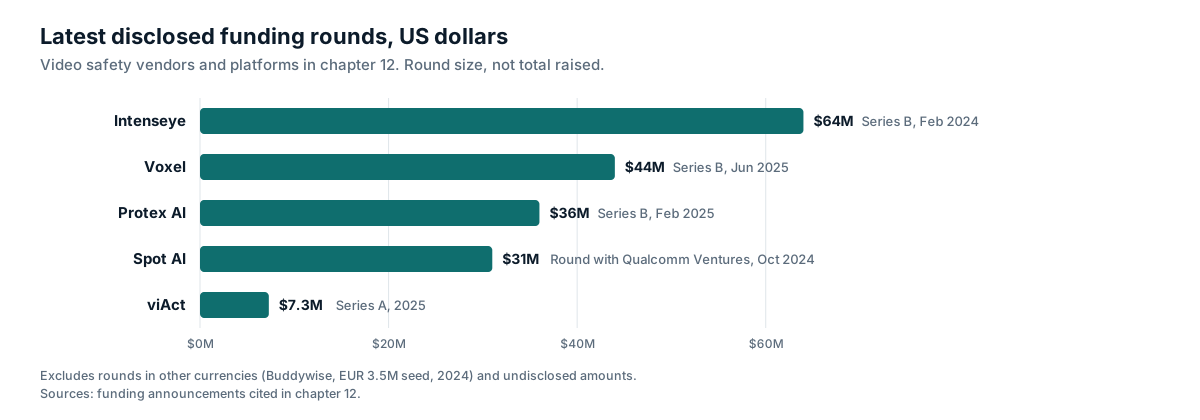
Investor identity tells you something. Insurers (Tokio Marine in Voxel), equipment makers (Rite-Hite in Voxel), retailers (W23 in Protex AI) and telecoms groups (Ericsson in Voxel, Singtel in viAct) invest for strategic reasons. That can mean distribution, integration or a future acquirer. It does not mean the investor has independently tested the product.
EHS software is consolidated and mostly privately owned
The established EHS vendors have mostly changed hands through private equity or corporate deals. Fortive's Industrial Scientific bought Intelex for about $570 million in 2019 [20]. Thoma Bravo became Cority's majority investor the same year [21]. CVC acquired VelocityEHS in 2017, and Partners Group took a significant minority stake in 2022 [22]. SafetyCulture remains venture-backed and raised A$165 million at an A$2.5 billion valuation in 2024 [23].
For buyers this means stable but slower-moving vendors, with acquisition-driven product suites whose modules sometimes come from different code bases. Ask which modules were built in house and which were acquired, and how deeply they share data.
Analysts now track video analytics for safety as its own segment
When an analyst firm publishes a dedicated benchmark, it usually means enough buyers are asking about the segment. Verdantix's Smart Innovators report on video analytics for safety, published in March 2026, assessed 10 vendors and noted strategic partnerships and investment activity across 2024 to 2026 [2]. Vendors quote these reports selectively; Protex AI, for example, announced that it was recognized for "market-leading functionality" [24], and other vendors have published their own excerpts. Read the method, and if possible the full report, before treating any placement as a buying signal.
Wearables show the risk of a narrow product
StrongArm raised a $50 million Series B led by Drive Capital in January 2022, which it described as the largest round raised by an industrial safety wearables company [18]. Kinetic's decision to retire its Reflex device shows the other side [19]. Wearables need workers to put them on every shift, charge them, and accept being measured. Vendors whose business depends on a single device face pressure that software-only vendors do not.
Where are category boundaries blurring?
Four movements are worth tracking because they change who you will be negotiating with in two or three years. This is outlook based on announcements to date.
- Video platforms are adding safety detections. Verkada and Spot AI already market PPE and zone alerts [17][10]. If your security team already runs one of these platforms, expect it to propose safety use cases.
- Computer vision vendors are adding hardware and control. Intenseye's Sentinel and Visionify's hard stop product move these vendors closer to the machine safety world [7][28].
- EHS suites are adding AI and integrations. Verdantix's 2025 report on EHS software highlighted AI features such as automated ergonomic assessments [3]. A suite that can ingest detections from any camera vendor reduces lock-in for the camera layer.
- Fleet vendors are moving onto the site. Samsara's Site Visibility and worker safety features extend a telematics platform into yards and buildings [15][25].
How should buyers read vendor claims?
Almost every vendor publishes outcome figures. Some examples from sources cited in this chapter: Protex AI says areas using its platform saw an average 64% risk reduction within three months of deployment [4]; Voxel's Series B announcement cited a 91% reduction in recordable injuries at deployed sites [8]; StrongArm said in 2022 that its customers saw a 45% year-over-year injury reduction [18]; Buddywise says Milliken saw a 73% reduction in observed safety risks in the first four weeks [13]. None of these figures has been independently verified by this guide. They may be accurate for the sites described. They are not predictions for yours.
Questions to ask about any percentage
- What was measured? "Risk" or "unsafe events detected by our system" is not the same as recordable injuries or lost-time cases. A drop in detected events can also mean workers learned where the cameras are.
- What is the baseline? Ask for the measurement period before and after, and whether the baseline was itself measured by the vendor's system during a silent period.
- How many sites, and which ones? A case study is a selected success. Ask how many sites the vendor has deployed in total and what share of them reported a comparable result.
- What else changed? New supervisors, layout changes, a fresh safety campaign or lower volumes can all move numbers. Chapter 15 covers attribution in detail.
- Is the number small? A 50% fall from four recordables to two is real for the workers involved, but it is not statistically meaningful at a single site.
Accuracy claims
Detection accuracy figures, such as Voxel's "96%+ detection accuracy" [31] or Buddywise's "up to 99%" [30], depend on the detection type, camera, lighting, the test set and whether accuracy means precision, recall or something else. Ask for precision and recall by detection type on footage from your own site during a pilot, measured by your team.
Customer logos and "Fortune 500" language
A logo on a website may represent one pilot at one site. Ask how many sites each named customer runs, for how long, and whether you can speak to the site lead rather than a corporate sponsor. Prefer customers in your own sector and region.
Analyst recognition and awards
Analyst benchmarks compare functionality and talk to customers, which is useful. They do not measure injury reduction at your site. Awards from media or business groups vary widely in rigor. Treat both as reasons to look at a vendor. The decision to buy should rest on your own pilot.
Return on investment calculators
Several vendors publish ROI calculators. These rest on assumptions about injury costs and the share of injuries the product prevents. Rebuild the calculation with your own claims data and a conservative prevention rate, and test what happens if the prevention rate is half the vendor's figure.
How do you build a shortlist from these categories?
A practical approach for most multi-site operators runs in five steps.
- Name the top three risks from your incident and near-miss data, by severity rather than frequency. Vehicle and pedestrian interaction, work at height and manual handling are common answers.
- Map each risk to a sensing method. Fixed cameras cover aisles, docks and yards well. Wearables cover body movement and lone work. Telematics covers vehicles away from site.
- Check your existing estate. Note your camera models, coverage and network, your EHS system and whether it has an API, and any video platform security already runs.
- Build a longlist of three to five vendors per relevant category, using the profiles in this guide and analyst reports as a starting point.
- Apply hard filters before demos: data residency, edge or cloud processing, privacy features, integration with your EHS system, references in your sector and region, and contract terms on data ownership and exit.
Chapter 14 covers request for proposal (RFP) questions, pilot design and acceptance criteria in detail.
Summary
Safety technology vendors fall into five groups that solve different problems: specialist AI video analytics on existing CCTV, broad video platforms, EHS software, wearables and sensors, and telematics. Most organizations will use more than one, with EHS software as the place where detections become actions.
Inside the AI video group, the meaningful differences are where video is processed, what data leaves the site, how detections are configured and reviewed, what privacy controls exist, and whether the system can act on equipment. Since 2024 investment has concentrated in a handful of specialist vendors such as Intenseye, Protex AI and Voxel, while large video platforms such as Verkada and Spot AI have added safety features and established EHS software sits mostly with private equity and industrial owners. Wearables have had a mixed commercial record, as Kinetic's retirement of its Reflex device shows.
Every outcome figure in vendor material is a claim from a selected customer. Ask what was measured, against what baseline, across how many sites, and what else changed. Use funding, analyst placement and customer logos to decide which vendors to look at, and use your own pilot data to decide which one to buy.
Frequently asked questions
+Which type of safety technology vendor should we look at first?
Start from the risk you most need to reduce and the data you already have. If vehicle and pedestrian interaction in a building with decent CCTV is the main concern, AI video analytics on existing cameras is usually the fastest test. If your incident reporting is still on paper or spreadsheets, an EHS platform comes first, because detections from any sensor need somewhere to go.
+Do we need to replace our cameras to use AI video safety analytics?
Usually not. Most specialist vendors say they connect to standard IP cameras over RTSP and add an on-site processing box. Broad video platforms such as Verkada and Spot AI generally work best with their own cameras, although some offer gateways for third-party streams. Camera angle, resolution and lighting still decide what any model can see, so expect a site survey.
+Are analyst rankings like Verdantix a reliable way to shortlist vendors?
They are a useful starting point because analysts compare functionality against a published method, and they talk to customers. They do not test outcomes at your site, and vendors often quote only the parts of a report that favor them. Use them to build a longlist, then run your own pilot.
+How much does AI video safety analytics cost?
Few vendors publish prices. Most quote a subscription per camera stream or per site, plus hardware for edge processing and sometimes setup fees. Ask for a three-year total cost that includes hardware refresh, additional cameras, integration work and the internal time needed to review alerts.
Related reading
- Buying and piloting40 questions to ask AI safety vendors: an RFP checklist
- Buying and pilotingSafety technology ROI: building an honest business case
- RegulationThe EU AI Act and Workplace Safety Systems: What Applies and When
- BuyingWhat AI Search Tells Buyers About Safety Vendors, and How to Check It
- BuyingWhat AI Video Safety Vendors Publish for Buyers: A Public Evidence Check
Sources
- [1]Verdantix: Market Size And Forecast: EHS Software 2023-2029 (Global)
- [2]Verdantix: Smart Innovators: Video Analytics For Safety (2026)
- [3]Verdantix: Green Quadrant: EHS Software 2025
- [4]Silicon Republic: Protex AI raises $36m to continue US expansion
- [5]Silicon Republic: Protex AI bags funds from grocery retail VC W23
- [6]SiliconANGLE: Intenseye, which uses AI computer vision to enhance workplace safety, raises $64M
- [7]PR Newswire: Intenseye launches Sentinel, a Physical AI hardware suite for real-time safety
- [8]HG Ventures: Voxel raises $44M in Series B funding
- [9]FinSMEs: Voxel receives investment from Ericsson Ventures
- [10]Spot AI: Spot AI introduces first Video AI Agents for the physical world as it nears $100 million in funding to date
- [11]TNGlobal: Hong Kong's AI firm viAct raises $7.3M Series A for expansion in MENA and Europe
- [12]Tech.eu: Buddywise's AI for workplace safety raises €3.5M seed
- [13]Buddywise: Milliken expansion to two continents
- [14]Business Wire: Samsara Reports Fourth Quarter and Full Fiscal Year 2026 Financial Results
- [15]Samsara: Announcing Site Visibility
- [16]Verkada: Announcing our $5.8B valuation
- [17]Verkada: Logistics security solutions
- [18]PR Newswire: StrongArm Technologies raises $50M Series B
- [19]Coverager: Kinetic retires wearables from workers' comp program
- [20]Kirkland & Ellis: Kirkland represents Fortive on Industrial Scientific's acquisition of Intelex for $570 million
- [21]Cority: Cority closes new growth investment with Thoma Bravo as majority investor
- [22]Partners Group: Partners Group to acquire a significant minority stake in VelocityEHS
- [23]SafetyCulture: SafetyCulture closes $165 million funding round
- [24]GlobeNewswire: Protex AI recognised in Verdantix Smart Innovators report on video analytics for safety
- [25]Samsara: Samsara unveils major expansion of AI-powered safety platform
- [26]Protex AI: Site intelligence platform (product and privacy pages)
- [27]CNBC: Security startup Verkada hits $5.8 billion valuation in latest funding round led by CapitalG
- [28]Visionify: AI-powered safety intelligence platform
- [29]Spot AI: Spot AI goes 100% channel and launches $2M equity program
- [30]Buddywise: Real-time risk detection (company website)
- [31]Voxel: Industrial intelligence platform (company website)
New chapters and updates, once a month
One email when we publish or update guidance. No vendor promotions. Unsubscribe any time.