Part 3: Industries · Chapter 11
Construction and infrastructure
Construction injury data from BLS, HSE and Eurostat, the Fatal Four hazards, CDM 2015 and OSHA rules, and how AI video, drones, BIM and wearables are used on sites.
By LIPAI WANG · Updated · 20 min read · 22 sources · 1 figure
Construction kills more workers than any other US industry and accounts for the largest share of worker deaths in Great Britain and close to a quarter in the EU. Most of those deaths come from a short list of causes: falls, being struck by vehicles and objects, being caught in or between equipment and materials, and electrocution. This chapter covers what the regulators' data shows, the rules that apply in the US, UK, EU and Hong Kong, the technology contractors are using, from AI cameras and wearables to drones and BIM, and the questions to ask before buying.
Construction and infrastructure here covers building, civil engineering, specialist trades and the construction phase of major infrastructure such as rail, roads, energy and data centers. Projects differ enormously in scale, but they share three features that shape how safety technology works: the workplace changes every week, many employers share one site, and much of the risk sits with subcontractors and short-tenure workers.
How many construction workers are killed and injured?
United States
The Bureau of Labor Statistics (BLS) counted 1,034 deaths in the construction industry in 2024, the most of any private industry sector, ahead of transportation and warehousing with 865 [2]. Construction accounted for about one in five US workplace deaths. Construction Dive's analysis of the BLS data puts the industry's fatal injury rate at 9.2 per 100,000 full-time equivalent workers, down from 9.6 in 2023 and the lowest since 2011 [3]. The full BLS release, published on February 19, 2026, reported 5,070 fatal work injuries across all industries [1].
By event, falls, slips and trips caused 389 construction deaths in 2024, about 38 percent of the total. Transportation incidents caused 244, exposure to harmful substances or environments 187, and contact with objects and equipment 161 [3].
CPWR, the Center for Construction Research and Training, reports that the four hazards OSHA calls the Focus Four (falls to a lower level, struck-by, caught-in/between and electrocution) cause almost two thirds of construction deaths, and falls alone more than a third in an average year [4]. OSHA builds its construction outreach training around the same four hazards [5]. The industry often calls them the Fatal Four.
OSHA citation data points the same way. Fall protection general requirements (29 CFR 1926.501) was again the most cited standard in fiscal year 2025, and five of the top ten were construction standards: fall protection, ladders, scaffolding, fall protection training, and eye and face protection [6]. OSHA has run a National Emphasis Program on falls, which directs enforcement attention to fall hazards, since May 1, 2023 [7].
Great Britain
The Health and Safety Executive (HSE) recorded 126 worker deaths in Great Britain in 2025/26 (provisional figures). Construction had 25, the highest of any sector [8][9]. Across all industries, falls from height caused 31 deaths, being struck by a moving vehicle 24, being struck by a moving object 21, and being trapped by something collapsing or overturning 18 [8]. Those four causes also dominate construction deaths.
For non-fatal injuries, HSE puts construction's self-reported rate at 2,500 per 100,000 workers, statistically significantly higher than the all-industry average of 1,780 [10]. Construction workers also carry long-term health risks that do not show up in injury data. HSE recorded 2,146 mesothelioma deaths in Great Britain in 2024, a legacy of asbestos exposure in earlier decades [9][22].
European Union
Eurostat's 2024 data shows 3,367 fatal accidents at work in the EU, and 23.0 percent of them happened in construction, the largest share of any sector. Construction also accounted for 12.7 percent of the 2.78 million non-fatal accidents that caused at least four days' absence [11].
Comparing the three
| Jurisdiction | Latest year | Construction deaths | Share of all worker deaths | Source |
|---|---|---|---|---|
| United States | 2024 | 1,034 | About 20% | [2][3] |
| Great Britain | 2025/26 (provisional) | 25 | About 20% (largest sector) | [8][9] |
| European Union | 2024 | About 770 | 23.0% | [11] |
The figures are not directly comparable. The US count includes self-employed workers and roadway deaths, HSE's count is based on deaths reported under RIDDOR, and Eurostat relies on national reporting systems with different coverage. In all three, construction carries a disproportionate share of fatal risk.
What are the main hazards on construction sites?
Falls from height
Falls happen from roofs, ladders, scaffolds, unprotected edges, openings in floors and mobile elevating work platforms. The causes are usually well known. Edge protection is missing or removed, harnesses are not worn or not anchored, ladders are used for work that needs a platform, fragile roof surfaces are not covered, and openings are left uncovered after a trade moves on. Short-duration jobs, where setting up proper access feels like more work than the task itself, account for many falls.
Technology plays a supporting role here. Cameras can detect people near unprotected edges or without harnesses in defined zones, and drones and 360-degree capture reduce the number of trips people make to height just to look at something. The control is still physical: guardrails, covers, scaffolds and work platforms, planned before work starts.
Struck-by
Workers are struck by moving plant (excavators, dumpers, telehandlers, delivery trucks), by vehicles in highway work zones, and by falling or swinging objects, including crane loads and dropped tools. Reversing vehicles and slewing excavators are recurring causes. Struck-by is the category where camera-based exclusion zones, proximity warning systems and 360-degree vehicle cameras are most widely used, because the hazard is visible and the rule ("no person within X meters of operating plant") is easy to define.
Caught-in/between
Trench collapses are the classic caught-in event: a worker buried when an unsupported excavation wall fails. Workers are also caught between plant and fixed objects, between materials, and in rotating equipment such as augers and mixers. Excavation support and inspection by a competent person are the controls. Sensors that monitor ground movement or trench box placement are available but less common than cameras and wearables.
Electrocution
Contact with overhead power lines (often by crane jibs, excavator booms, scaffold poles or ladders), buried cables struck during excavation, and temporary site wiring cause most electrocutions. Cable avoidance tools and ground-penetrating radar are long-established technologies for buried services. Some proximity systems on cranes and excavators warn operators as booms approach a defined power line zone.
Health hazards
Silica dust from cutting concrete and stone, asbestos in older buildings, noise, vibration, and heat all cause long-term harm. Heat is getting more regulatory attention. OSHA proposed a federal heat injury and illness prevention rule in August 2024 and held hearings in June and July 2025. No final rule had been published at the time of writing [21]. Wearables that monitor heat strain and environmental sensors are used on some large sites.
Which regulations apply?
United States
OSHA's construction standards (29 CFR Part 1926) cover fall protection (Subpart M), scaffolds (Subpart L), ladders (Subpart X), excavations (Subpart P), cranes (Subpart CC), electrical work and more. They are written around physical controls, competent persons and training. None of them requires camera monitoring or wearables. Contractors adopt those tools to help meet their duties and to reduce the risk of the incidents behind the most common citations [6].
United Kingdom: CDM 2015
The Construction (Design and Management) Regulations 2015 came into force on April 6, 2015 [12]. They set out duties for clients, designers, principal designers, principal contractors, contractors and workers [14]. The principal designer plans, manages, monitors and coordinates health and safety in the pre-construction phase, and the principal contractor does the same in the construction phase [14]. A construction phase plan is required for every project, including single-contractor jobs [14].
A project must be notified to HSE if the construction work is scheduled to last longer than 30 working days with more than 20 workers working at the same time at any point, or to exceed 500 person days [13].
CDM 2015 matters for technology in two ways. The principal contractor's duty to monitor health and safety during the construction phase is where site monitoring tools fit, as one way of carrying out that duty. And the principal designer's duty to eliminate or reduce foreseeable risks during design is where BIM and digital design reviews can contribute, for example by modeling edge protection, crane positions and site logistics before work starts.
European Union
Council Directive 92/57/EEC of June 24, 1992 sets minimum requirements for temporary or mobile construction sites. Where several firms work on a site, the client or project supervisor must appoint a safety and health coordinator. A health and safety plan must be drawn up before work starts. Prior notice must be given to the authorities for sites expected to last more than 30 working days with more than 20 workers at once, or more than 500 person days [15]. CDM 2015 implemented the same directive in Great Britain, which is why the notification thresholds match.
Hong Kong: Smart Site Safety System
Hong Kong is unusual in making site safety technology a contract requirement. Through Technical Circular (Works) No. 3/2023, the Development Bureau requires a Smart Site Safety System, known as 4S, on public works contracts with a contract sum above HK$30 million [16]. The circular takes a risk-based approach: contractors apply 4S solutions to address the risks identified on each project. The Construction Industry Council runs a 4S labelling scheme so that public and private projects can show they meet the standard [16]. 4S has given vendors a regulated market in Hong Kong, and buyers elsewhere can use it as a reference model for how a client can specify site safety technology in a contract.
What safety technology is used on construction sites?
AI video analytics
Construction sites use AI video analytics for many of the same tasks as factories, but under harder conditions. Cameras are mounted on temporary poles, hoardings, cranes and solar-powered towers. Connectivity is often cellular. The scene changes as structures go up, so a camera with a clear view in month two may be blocked in month four.
Common use cases on construction sites are:
| Use case | What the system looks for | Practical issues |
|---|---|---|
| PPE | Hard hats, high-visibility clothing, harnesses in defined zones | Many sites now use mandatory PPE everywhere, so alerts can become constant without zone rules |
| Plant and pedestrian exclusion | People within a set distance of excavators, cranes, piling rigs | Zones must move with the plant; some systems combine cameras on the machine with site cameras |
| Working at height | People near open edges, people at height without harnesses | Edges change as the building rises |
| Lifting operations | People under suspended loads | Requires a view of the load path |
| Site access and security | Unauthorized entry, out-of-hours intrusion | Overlaps with security monitoring the site may already pay for |
| Fire and smoke | Early smoke detection in hot work areas and stores | Dust and steam can trigger false alarms |
viAct, a company headquartered in Hong Kong, sells AI video analytics for construction and other industries. Its website lists use cases including PPE detection, danger zone intrusion, working at height and confined space monitoring, and names Shui On Construction, Bouygues Travaux Publics, ALEC Engineering and Contracting and MTR Corporation among its customers. viAct claims "95% Less Accidents" and "70% Less Manpower Cost" following deployment and references recognition under Hong Kong's 4S program [17]. The website does not explain how the accident figure was measured or over what period, and it has not been independently verified.
Several other AI video vendors covered in chapter 12 also serve construction alongside manufacturing and logistics. Before buying, check whether a vendor has worked on sites with similar phases and conditions: a vendor proven on a static warehouse may struggle with a site where the camera positions move every few weeks.
Reality capture, 360-degree imaging and progress tracking
Many of the most widely adopted construction technologies are built for progress tracking, with safety as a by-product. Reality capture tools record what has been built, usually with 360-degree cameras worn on a hard hat or carried during a site walk, and compare it with the plans.
OpenSpace describes itself as a visual intelligence platform. Teams capture site imagery with 360-degree cameras, drones and phones and compare it with plans and BIM models. The company says it has captured 77 billion square feet across 132 countries and lists Balfour Beatty, Skanska and Suffolk among its users [19]. Buildots uses captured site data compared against BIM models and schedules to track progress, and says its approach can "reduce delays by up to 50%." Its customers include JE Dunn, Mortenson and Intel, and it offers a workforce product that it says covers safety, logistics and resource tracking [18].
These tools help safety indirectly. A site record lets safety managers check edge protection, housekeeping and temporary works remotely, gives evidence for investigations, and helps catch hazards such as missing guardrails or uncovered openings during routine reviews. A buyer should not expect a progress-tracking tool to work as a real-time alerting system.
Robots for site documentation
Boston Dynamics markets its four-legged Spot robot for construction progress monitoring, 360-degree capture and laser scanning, including access to hazardous or hard-to-reach areas. It lists Turner Construction, Strabag, Suffolk, Brasfield & Gorrie and Acciona among construction users [20]. The safety argument is that a robot can repeat the same capture route without putting a person in a hazardous area, such as an active demolition zone or a space with poor air quality. Deployments are still concentrated on large projects with the budget and the staff to run them.
Drones
Drones are used for site surveys, earthworks volumes, roof and facade inspections, and progress imagery. Their safety benefit is mainly that they reduce the number of times people climb to inspect something. Drone operations bring their own risks and rules: in the US, commercial flights fall under the Federal Aviation Administration's Part 107 rules, and in the UK and EU under civil aviation authority requirements. Flights over workers, near cranes and in congested urban sites need careful planning.
BIM and digital twins
Building information modeling (BIM) is a shared 3D model of a project that holds geometry and data about every element. For safety, BIM supports planning and design review: modeling crane positions and lift zones, scaffold and edge protection sequences, site logistics and traffic routes, and temporary works. Under CDM 2015, this is one way designers and principal designers can show they have considered how a structure will be built safely [14].
A digital twin goes further by linking the model to live data, such as sensor readings, progress capture, plant locations and access control. On construction projects, digital twins remain mostly at the stage of combining progress capture with BIM. Linking live safety events into the model is less common, and chapter 16 covers where that may go.
Wearables and proximity systems
Construction wearables include:
- Proximity tags (UWB, RFID or Bluetooth) on workers that trigger alerts when plant comes too close. Some systems also slow or stop the machine.
- Smart hard hats and clip-on devices with fall detection, location, lone worker alarms and gas detection.
- Heat strain monitors that track heart rate and skin temperature.
- Access control linked to training records and permits, so only qualified workers enter certain zones.
Proximity systems for plant are the most mature of these on large civil engineering projects, where excavators and dumpers work close to people every day. Their main operational challenges are tag compliance (workers leaving tags in vans or letting them go flat) and nuisance alarms in tight working areas, which lead operators to ignore warnings. Chapter 6 covers the technology in depth.
Site management and EHS software
Digital permits to work, inductions, toolbox talk records, inspections and incident reporting are now common on larger sites, often in the same platform the contractor uses for quality and document control. These systems connect monitoring data with the people who must act on it. A camera alert about an excavation without edge protection is most useful when it creates an action against the permit holder for that excavation. Chapter 7 covers EHS software and integration.
How are construction deployments different from fixed sites?
Power, connectivity and mobility
A factory deployment can use existing cameras, wired networks and a server room. A construction site usually has none of these at the start. Vendors offer camera towers with solar panels and batteries, cellular routers, and edge devices housed in site cabins. Budget for relocating cameras as the work progresses and for someone to own the hardware day to day.
Multi-employer sites
On a typical site, the principal contractor employs a minority of the workers. Subcontractors bring their own people, often for a few weeks. That affects privacy notices and consultation, which must reach every worker, including subcontractors' staff. It also affects follow-up, which often goes through the subcontractor's supervisor, and contracts, which should say how subcontractors are expected to respond to monitoring data. It is worth agreeing these points in subcontract terms before installation.
Project lifespan
Most projects last months to a few years. A system that takes six months to tune delivers little on an 18-month job. Contractors that get most value from site technology tend to standardize it across their projects, reuse hardware, and carry settings and lessons from one site to the next.
Phases and changing hazards
Hazards shift through the project: earthworks and piling, then frame and envelope, then fit-out and commissioning. The detection rules that matter in groundworks (plant exclusion, excavation edges) differ from those in fit-out (working at height on mobile platforms, hot work, housekeeping). Ask vendors how they handle changing phases and whether pricing allows use cases to be switched on and off.
Where technology sits in the hierarchy of controls
The hierarchy of controls ranks risk controls from elimination and substitution, through engineering controls, to administrative controls and personal protective equipment. Most site safety technology sits in the administrative tier. A camera that flags a person without a harness near an open edge prompts a supervisor to act, but the edge is still open. A proximity tag that warns an excavator operator relies on the operator responding. Technology rises higher in the hierarchy only when it changes the work itself: BIM-based planning that designs out an edge, a crane limiter that physically prevents a slew into a power line zone, or a machine interlock that stops plant when a tagged worker is too close.
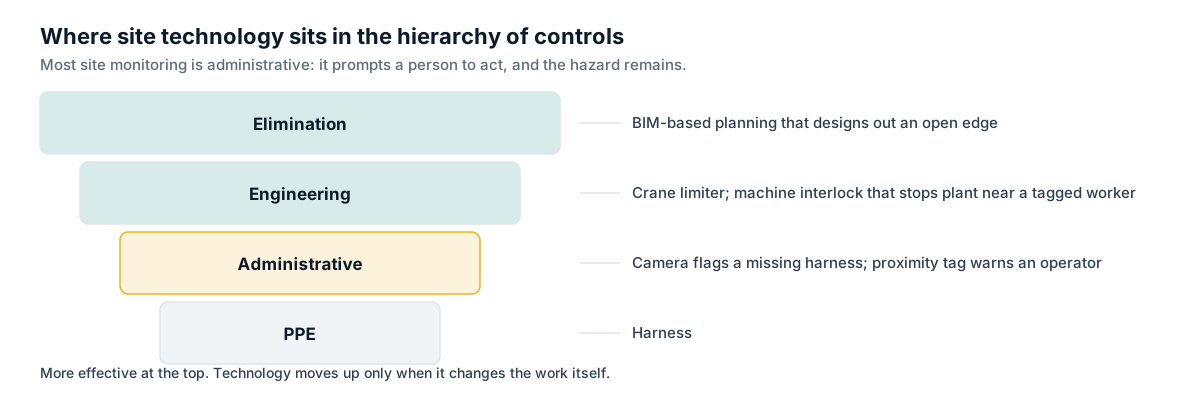
This matters for how a contractor presents technology to clients, regulators and its own workforce. Monitoring data is useful evidence that controls are working or failing. It is weak evidence that the risk has been controlled, and investigators will ask what physical measures were in place regardless of how many alerts the system produced. The most effective use of site monitoring data is to find where higher-tier controls are missing and fix them, for example by adding permanent edge protection to an area that keeps producing working-at-height alerts.
What should buyers ask vendors?
About site conditions
- What hardware do you supply for sites without existing cameras, power or network? Who installs, moves and maintains it?
- How does detection perform in rain, dust, low sun, night work and under temporary lighting?
- How often do exclusion zones and camera views need re-mapping as the work progresses, and how long does it take?
About use cases and accuracy
- Which Fatal Four hazards can your system detect, and which can it not?
- What precision and recall do you measure on construction footage similar to ours? Can we validate it during a pilot?
- How do you handle sites where PPE is mandatory everywhere, so alerts are meaningful rather than constant?
About outcomes and evidence
- For each outcome figure you publish, what was the baseline, how many projects and workers were included, and over what period?
- Can we speak to a contractor who has used the system across more than one project and through several project phases?
- How do you separate a fall in detected events from changes in camera coverage as the site evolves?
About people and contracts
- How do you support privacy notices and consultation for subcontractor workers, not just our direct employees?
- What data do you retain, where, and for how long? Can we disable identification of individuals?
- Does the system meet any client specification we must comply with, such as Hong Kong's 4S requirements on public works?
About integration and cost
- Can events flow into our permit, inspection and incident systems?
- Is pricing per camera, per project, per month, or per use case, and what happens at project close-out?
- Can hardware move to the next project, and who pays for redeployment?
Chapter 14 explains how to turn these questions into a pilot with acceptance criteria. Chapter 15 covers how to measure outcomes honestly on projects with changing headcount and phases.
Summary
Construction remains the most dangerous large industry in the US, Great Britain and the EU. BLS recorded 1,034 US construction deaths in 2024 at a rate of 9.2 per 100,000 workers, HSE recorded 25 construction deaths in Great Britain in 2025/26, and construction accounted for 23 percent of EU fatal work accidents in 2024 [2][3][8][11]. Falls, struck-by, caught-in/between and electrocution cause most of those deaths [4].
The rules in the US, UK and EU require planning, coordination and physical controls, and CDM 2015 places specific duties on clients, designers and contractors. They do not mandate technology, with Hong Kong's 4S requirement for large public works as the main exception [16]. Contractors are adopting AI video, proximity wearables, drones, 360-degree capture and BIM, though many of those tools are bought mainly for progress tracking and documentation. Vendor outcome claims, such as viAct's reported 95 percent reduction in accidents, come from the vendors themselves and should be tested on a buyer's own sites. On construction, a technology choice depends as much on how the system copes with moving cameras, short projects and subcontracted workforces as on detection accuracy.
Frequently asked questions
+Do AI cameras work on construction sites that change every week?
They can, but the deployment looks different from a factory. Sites usually rely on solar or temporary-power camera towers, cellular or site Wi-Fi backhaul, and regular re-mapping of exclusion zones as the work moves. Ask vendors how often zones need updating and who does it.
+Is site safety technology required by law?
In most jurisdictions no. US OSHA rules, the UK's CDM 2015 and the EU's construction sites directive require planning, coordination and control of risks but do not specify technology. Hong Kong is an exception for public works: its Development Bureau requires a Smart Site Safety System on public works contracts above HK$30 million.
+Who should buy safety technology on a construction project: the client or the contractor?
Usually the principal or general contractor, because it controls the site and the construction phase. Clients increasingly write technology requirements into contracts, as Hong Kong's public works program does, and in the UK the client has a duty under CDM 2015 to make suitable arrangements for managing the project.
+Can drones replace safety inspections on site?
Drones help with inspections of roofs, facades, earthworks and other areas that are hard or dangerous to reach, and they cut the time people spend at height for routine checks. They do not replace a competent person's inspection of scaffolds, excavations or fall protection systems where the rules require one.
Sources
- [1]BLS: Census of Fatal Occupational Injuries Summary, 2024 (released February 2026)
- [2]BLS The Economics Daily: Fatal work injuries declined in 2024
- [3]Construction Dive: Construction's deaths, fatality rate declined in 2024
- [4]CPWR: Construction Focus Four dashboard
- [5]OSHA: Construction Focus Four training
- [6]OSHA: Top 10 Most Frequently Cited Standards
- [7]OSHA: National Emphasis Program on Falls, CPL 03-00-025
- [8]HSE: Work-related fatal injuries in Great Britain
- [9]HSE press release: Latest annual work-related fatalities published (July 2026)
- [10]HSE: Industry statistics
- [11]Eurostat: Accidents at work statistics
- [12]The Construction (Design and Management) Regulations 2015, regulation 1
- [13]The Construction (Design and Management) Regulations 2015, regulation 6
- [14]HSE: CDM 2015 legal requirements summary
- [15]EU-OSHA: Directive 92/57/EEC on temporary or mobile construction sites
- [16]Construction Industry Council (Hong Kong): Smart Site Safety System Labelling Scheme
- [17]viAct: company website
- [18]Buildots: company website
- [19]OpenSpace: company website
- [20]Boston Dynamics: Spot for construction
- [21]OSHA: Heat Injury and Illness Prevention rulemaking
- [22]HSE: Key figures for Great Britain
New chapters and updates, once a month
One email when we publish or update guidance. No vendor promotions. Unsubscribe any time.