Buying and piloting
What 43 safety technology vendors publish for buyers: the 2026 evidence dataset
An open dataset of what 43 workplace safety technology vendors make public: security and privacy documents, pricing, accuracy methods, independent evidence and more. Free to download under CC BY 4.0.
By LIPAI WANG · Updated · 7 min read · 5 sources · 1 figure
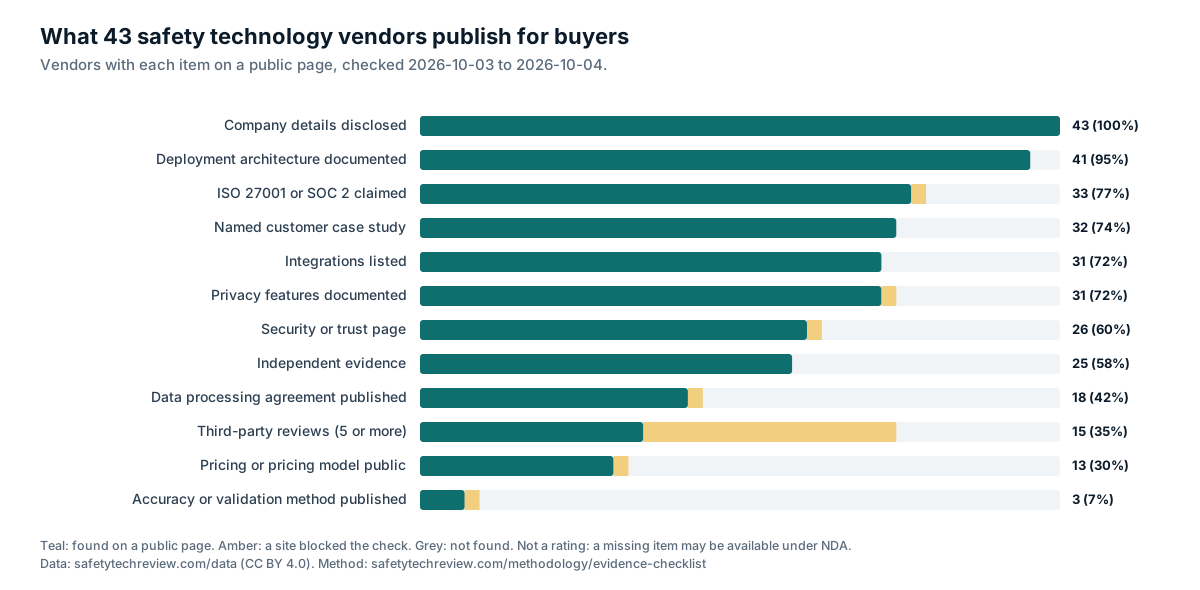
Before a sales call, a buyer can usually learn who a safety technology vendor is and how its product is installed. What they usually cannot learn is how accurate the product is, what it costs or how it handles workers' data. That is the main finding from checking the public pages of 43 vendors against the same twelve items on 3 and 4 October 2026 [1].
The full results are published as an open dataset, free to reuse with credit [2][3][5]. This article summarizes what it shows and how to use it.
What we checked
Every vendor in our directory was checked against the same twelve items: a security or trust page, a published data processing agreement (DPA), an ISO 27001 or SOC 2 claim, documented privacy features, documented deployment architecture, public pricing or a pricing model, a published accuracy or validation method, independent evidence, a named customer case study, listed integrations, company details, and at least five third-party reviews [1]. An item counts only if a public page showed it on the day we checked, and the profile links to that page [4].
The 43 vendors cover AI video safety analytics (14), wearables and sensors (9), EHS software (9), video platforms (6) and other safety technology such as proximity and forklift systems (5) [2].
Five findings
Accuracy methods are almost never public. Only 3 of 43 vendors publish how they measure detection accuracy or validate their models [2]. Many more publish accuracy figures or customer results, but without the method a buyer cannot tell what was counted, on which footage, or over what period. Ask for precision and recall per detection type, measured in conditions like yours, before a pilot is agreed.
Pricing is mostly hidden. 13 of 43 vendors show prices or a pricing model in public [2]. The rest require a sales conversation, which makes early budget comparisons hard. Ask for the full three-year cost, including hardware, installation and any per-camera or per-user fees.
Data protection documents are uneven. 33 vendors claim ISO 27001 or SOC 2 and 26 have a security or trust page, but only 18 publish a data processing agreement [2]. For any system that films or measures workers, ask for the DPA, the list of sub-processors and the data retention settings in the first round.
Independent evidence exists for just over half. 25 of 43 vendors have at least one piece of evidence not produced by the vendor itself, such as a peer-reviewed study, an analyst report or a public purchasing contract [2]. Independent evidence was rarer among wearables vendors (4 of 9) than among EHS software vendors (8 of 9).
Reviews are hard to verify. Third-party review sites blocked our automated checks for 17 vendors, so that item is the least complete in the dataset [2]. Where we could check, 15 vendors had at least five reviews on a third-party platform.
Differences by category
EHS software vendors publish the most, with a median of 10 of the 12 items, followed by video platforms (8). AI video safety analytics and wearables vendors publish a median of 6, and the other safety technology vendors a median of 5 [2]. The biggest gaps between categories are in data processing agreements (6 of 9 EHS software vendors publish one, 4 of 14 AI video vendors and 1 of 9 wearables vendors) and security pages (8 of 9, 8 of 14 and 3 of 9) [2].
Each item, and what to request when it is missing
The table lists every item in the order of how often vendors publish it [2]. The last column is the document or answer to request from any vendor that does not publish the item.
| Item | Vendors that publish it | What to request if it is missing |
|---|---|---|
| Company details disclosed | 43 of 43 | The legal entity you will contract with and where it is registered. |
| Deployment architecture documented | 41 of 43 | An architecture diagram showing what runs on site, what goes to the cloud and what happens during an internet outage. |
| ISO 27001 or SOC 2 claimed | 33 of 43 | The certificate or report itself, its scope and its date, not only a logo. |
| Named customer case study | 32 of 43 | A reference call with a customer in conditions like yours, plus one who stopped using the product. |
| Privacy features documented | 31 of 43 | Whether blurring, identity features and retention can be set per site, and who can change them. |
| Integrations listed | 31 of 43 | How alerts reach your EHS system, and who builds and maintains the connection. |
| Security or trust page | 26 of 43 | The latest penetration test summary and the incident notification commitment. |
| Independent evidence | 25 of 43 | Any study, audit or customer evaluation not written by the vendor, with the full method. |
| Data processing agreement published | 18 of 43 | The data processing agreement, the sub-processor list and where the data is stored. |
| Third-party reviews (5 or more) | 15 of 43 | Reviews from organizations of your size and sector, read for complaints about support. |
| Pricing or pricing model public | 13 of 43 | A three-year cost covering hardware, installation, licences, support and price rises. |
| Accuracy or validation method published | 3 of 43 | Precision and recall per detection type, the footage and period used, and how results were checked. |
The same items by category
Categories differ in size, so compare the share within each category rather than the raw counts [2].
| Category | Vendors | Median items found | Security page | DPA | Pricing | Independent evidence |
|---|---|---|---|---|---|---|
| AI video safety analytics | 14 | 6 of 12 | 8 | 4 | 3 | 7 |
| EHS software | 9 | 10 of 12 | 8 | 6 | 4 | 8 |
| Wearables & sensors | 9 | 6 of 12 | 3 | 1 | 3 | 4 |
| Video platform | 6 | 8 of 12 | 5 | 4 | 3 | 2 |
| Other | 5 | 5 of 12 | 2 | 3 | 0 | 4 |
How the checks were done
Each vendor's own website was read first: product, security, legal, pricing, customer and documentation pages. We then searched for independent sources such as peer-reviewed studies, analyst reports, public purchasing records and regulator documents, and for review listings on third-party platforms [1]. An item was recorded as found only with a link to the page that shows it. Certification and outcome claims were recorded as the vendor's claims; we did not verify certificates with the issuing bodies. When a site blocked automated access, we retried through an archived copy where one existed, and otherwise marked the item as not checked rather than not found [1][2].
Each vendor's profile in the directory shows its own checklist with the source for every item, and the dataset records the date each vendor was checked [2][3].
How to use the data
- Plan your first-round questions. Each missing item for a vendor on your shortlist is a document to request. The buying and piloting chapter explains how to turn them into an RFP.
- Compare vendors side by side. The vendor directory can filter vendors by the items you need, and the comparison table shows every item for every vendor.
- Reuse the dataset. Download the CSV or JSON from the data page. Each row is one vendor, with the status of every item and the link to the page where we found it [2][3].
Limits
This is desk research, not a test of products. A vendor with few public items may have an excellent product and share its documents under NDA, and a vendor with many items may still be a poor fit for your site [1]. The checks reflect public pages on two days in October 2026. Vendors can send corrections with a public link, and we recheck them for the next edition.
Frequently asked questions
+Can I use this data in my own report or procurement document?
Yes. The dataset is published under the Creative Commons Attribution 4.0 licence. Credit Safety Tech Review and link to safetytechreview.com/data.
+Does a vendor with more items have a better product?
No. The checklist measures what a buyer can verify from public pages before a sales call. It says nothing about detection quality or safety outcomes, which we have not tested.
+How often is the dataset updated?
Vendor evidence is rechecked when a profile is reviewed, and a new dated edition of the dataset is published after each round of checks.
+A vendor's entry is wrong or out of date. What should they do?
Send a correction with a link to the public page that shows the item. We recheck it and update the profile and the next edition of the dataset.
Related reading
Sources
- [1]Safety Tech Review, Public evidence checklist: method
- [2]Safety Tech Review, Vendor evidence dataset, edition 2026-10 (CSV)
- [3]Safety Tech Review, Vendor evidence dataset, edition 2026-10 (JSON)
- [4]Safety Tech Review, Vendor directory A to Z
- [5]Creative Commons, Attribution 4.0 International (CC BY 4.0)
Get the free Safety Tech Buyer's Toolkit
A 15-page PDF: the public evidence checklist, a weighted vendor scorecard, 40 RFP questions and pilot acceptance criteria. Subscribe and download it straight away; then one email a month when we publish or update guidance. No vendor promotions. Unsubscribe any time.