Part 2: Safety technology today · Chapter 6
Wearables, Sensors and Proximity Systems
How safety wearables, gas and heat monitors, ergonomic sensors and forklift proximity systems work, what the evidence shows, and how they compare with AI video.
By LIPAI WANG · Updated · 19 min read · 25 sources · 1 figure
Safety wearables and sensors are devices worn by workers, mounted on vehicles or fixed in an area that measure hazards directly: toxic gas, heat strain, noise, body posture, falls, and the distance between a person and a moving vehicle. They complement AI video because they work where cameras cannot see and measure things cameras cannot detect, but they only protect people who wear them correctly. This chapter covers the main device categories, how each technology works, what independent evidence exists, and what to check before buying.
Wearables are older than AI video in most workplaces. Personal gas detectors, noise dosimeters and man-down alarms have been standard equipment in oil and gas, utilities and mining for decades. What has changed is connectivity. Devices that once beeped locally now send readings over cellular, satellite or site networks to cloud dashboards, where safety teams can see alarms, locations and trends in real time.
What categories of safety wearables and sensors exist?
| Category | What it measures | Typical form | Example vendors |
|---|---|---|---|
| Connected gas detection | Oxygen, flammable gas, toxic gases | Clip-on personal monitor, area monitor | Blackline Safety [1] |
| Lone worker and man-down | Falls, no-motion, panic button, location | Clip-on or phone app | Blackline Safety [1] |
| Heat stress monitoring | Heart rate, estimated core body temperature | Armband | SlateSafety [4] |
| Ergonomic wearables | Trunk bending, twisting, lifting, repetition | Sensor on chest, back, hip or belt | StrongArm [6], Modjoul [8]; Kinetic Reflex (being retired) [7][25] |
| Proximity warning and collision avoidance | Distance between people and vehicles | Personal tag plus vehicle unit | Modjoul HaloGuard [9], Litum [10] |
| Location and site presence | Who is where on a site | Worker tag, gateways | Triax Spot-r (Invixium) [11], Litum [10] |
| Noise exposure | Sound dose over a shift | Dosimeter on shoulder | Various |
| Exoskeletons | Not a sensor; provides mechanical support | Worn frame for back, shoulder or arms | Various |
How do connected gas detectors and lone worker devices work?
Gas detection
Portable gas detectors use electrochemical, catalytic bead, infrared or photoionization sensors to measure oxygen levels, flammable gases expressed as a percentage of the lower explosive limit (LEL), and toxic gases such as hydrogen sulfide (H2S) and carbon monoxide (CO). They alarm locally with sound, light and vibration when readings cross set thresholds.
Regulation makes gas monitoring a firm requirement in some situations. OSHA's permit-required confined spaces standard requires employers to test the atmosphere before entry with a calibrated direct-reading instrument, first for oxygen, then for combustible gases and vapors, and then for toxic gases and vapors. It also requires testing or monitoring during entry as necessary to confirm acceptable conditions are maintained [2].
Connected detectors add a network link, so an alarm reaches a monitoring team as well as the wearer. Blackline Safety sells connected wearables including the G7x multi-gas detector with satellite connectivity and the newer G8, along with the EXO area monitor and the Blackline Live monitoring software. It says its devices support more than 20 gas sensor types and that it protects more than 165,000 workers in more than 75 countries [1]. Those are company figures.
Lone worker and man-down detection
A lone worker is someone who works without close or direct supervision. The UK Health and Safety Executive (HSE) says employers must manage health and safety risks before people can work alone, and notes that lone workers face greater risks because no one may be available to help if something goes wrong [19].
Lone worker devices typically combine:
- A panic or SOS button.
- Fall detection, using an accelerometer to detect a sudden drop followed by impact.
- No-motion detection, which raises an alarm if the device stays still for too long.
- Location from GPS outdoors or from indoor beacons.
- A missed check-in alarm if the worker does not confirm they are safe at set intervals.
- Two-way voice in some devices.
The main operational question is who answers the alarm. Some vendors offer 24/7 monitoring centers; Blackline lists professional monitoring among its services [1]. Others route alarms to internal teams. Response procedures, escalation contacts and testing routines matter as much as the hardware.
How do heat stress and noise monitors work?
Heat stress
Heat stress wearables estimate physiological strain rather than air temperature. SlateSafety's BAND V2 is an armband that monitors heart rate and estimates core body temperature, sending alerts to the wearer and to supervisors through web and mobile applications [4].
A 2021 systematic review in Sensors of physiological monitoring for occupational groups covered 38 studies, mainly involving firefighters and construction workers, and found that heart rate, thermal responses and accelerometry were the most common measures. The authors concluded that wearable sensors proved valid for assessing physiological status at work, and recommended more research on real-time feedback to workers [17].
Regulation may increase demand. OSHA published a proposed Heat Injury and Illness Prevention rule on August 30, 2024, covering indoor and outdoor work in general industry, construction, maritime and agriculture. An informal public hearing ran from June 16 to July 2, 2025, and post-hearing comments closed on October 30, 2025. As of this writing, OSHA has not issued a final rule [5]. Whether a final rule will require or encourage physiological monitoring is not yet known.
Noise
Noise dosimeters are worn on the shoulder near the ear and record sound levels over a shift. OSHA's noise standard sets an action level of an 85-decibel eight-hour time-weighted average, at which a hearing conservation program is required, and requires a monitoring program when exposures may reach that level [3]. Connected dosimeters and smart hearing protection add real-time alerts and central records, but the measurement principle is well established.
How do ergonomic wearables work?
Sensors and feedback
Ergonomic wearables usually contain an inertial measurement unit (IMU), which combines an accelerometer and gyroscope, sometimes with a magnetometer. Worn on the chest, upper back, hip or belt, the sensor tracks trunk angle, twisting, lifting speed and repetition. Many devices give haptic feedback, a short vibration, when the wearer makes a movement the system classifies as high risk. Data is uploaded to dashboards that show risk scores by person, team, shift or task.
StrongArm describes its SafeWork Sensor as a wearable that gives real-time haptic feedback, collects movement data and feeds AI-driven microlearning based on each worker's risk profile. The company claims a 35 percent average year-over-year reduction in soft tissue injuries, up to 89 percent injury reduction in its top-performing programs, and a return on investment above 250 percent at scale [6]. These are company claims and have not been independently verified.
Kinetic now sells workers' compensation insurance for frontline industries, and its website still lists Reflex wearable devices among its safety technology [7]. On September 30, 2026, Coverager reported that Reflex is no longer available to new policyholders and will be fully retired for existing policyholders by October 1, 2027, as Kinetic moves its technology investment toward claims intelligence. Kinetic says coverage, claims service and dividend eligibility are unchanged, and that employers actively engaged with its program have 34 percent lower loss ratios, a company figure [25]. For buyers, the episode shows that a wearable program depends on the vendor's continued commitment to the device. Ask about the product roadmap, notice periods, and what happens to devices and historical data if a product is withdrawn.
Modjoul sells the SmartBelt, a belt-mounted wearable that it says detects lumbar risk, repetitive motion, lone worker incidents, temperature warnings and other conditions, and pairs the belt with forklift collision avoidance [8].
What the research says
The academic evidence that wearables can measure posture and movement is strong. A 2024 systematic review in the International Journal of Environmental Research and Public Health screened research from 2000 to 2023 and selected 111 papers that used wearable sensor systems to examine workers' movements during tasks. It mapped which job sectors had been studied and identified under-researched tasks [15]. A 2022 review in Diagnostics found that combining wearable sensors such as IMUs with machine learning offered useful preventive possibilities for musculoskeletal disorders [16].
Evidence that wearing a device reduces injuries over the long term is thinner. Most published outcome data comes from vendors and their customers, often without control groups. Some reported improvement may come from other changes made at the same time, such as new equipment, retraining or more management attention. Chapter 15 discusses how to design a baseline and comparison so a site can judge results for itself.
Exoskeletons
Exoskeletons are not sensors, but they are often sold alongside ergonomic programs. Passive exoskeletons use springs or elastic elements to support the back, shoulders or arms during lifting or overhead work. A 2021 systematic review and meta-analysis in Applied Ergonomics found that exoskeletons seem to reduce acute physical stress and strain in the body area they support. The authors concluded that the effect on workers' health is unclear because long-term evaluations under real working conditions are lacking, and they called for studies that meet higher methodological standards [18].
How do proximity warning and collision avoidance systems work?
The problem they address
Vehicle-pedestrian collisions are among the most serious workplace hazards, as Chapter 5 describes. OSHA's powered industrial truck guidance recommends physical separation where possible, and notes that many pedestrians and bystanders are injured in forklift-related incidents [23]. Proximity warning systems (PWS) add an electronic layer: they detect when a person and a vehicle, or two vehicles, come too close, and alert the driver, the pedestrian or both.
Technologies
| Technology | How distance is estimated | Strengths | Limitations |
|---|---|---|---|
| Ultra-wideband (UWB) | Time of flight of short radio pulses between tags | Accurate ranging, works through some obstacles | Requires tags on all people and vehicles |
| Bluetooth Low Energy (BLE) | Signal strength between beacon and receiver | Low cost, widely available | Signal strength varies with body position and obstacles |
| RFID | Tag detected within a reader's field | Simple, durable | Coarse distance, field shape can be irregular |
| Radar and ultrasonic | Reflections from objects | No tags needed on people | Detects all objects, which increases nuisance alarms |
| Cameras with AI on the vehicle | Object detection in camera view | No tags needed, can distinguish people from objects | Lighting, occlusion, field of view |
| GPS | Satellite positioning | Outdoors over large areas | Poor indoors, limited accuracy for close distances |
UWB has become common for forklift systems in warehouses because it can measure distance precisely. Modjoul says its HaloGuard system uses UWB in the 6240 to 6739.2 MHz range, with SmartBelt tags on workers, modules on forklifts and an in-cab alert box, and that it can alert both driver and pedestrian with vibration, sound and light and can reduce vehicle speed automatically [9]. Litum, a real-time location systems company, sells a collision warning product called PathAware and says its platform offers sub-meter accuracy with UWB alongside BLE, GPS and LoRaWAN [10].
What the research says
Academic work on proximity warning goes back decades, especially in mining. In 2006, Todd Ruff of NIOSH published a two-year evaluation of a radar-based proximity warning system on large off-highway dump trucks at a surface mine. The system reliably detected small vehicles, berms, people and other equipment. However, alarms from objects that posed no immediate danger were common, and Ruff concluded that sensor-based proximity warning should be combined with other devices, such as cameras, so operators can check the source of an alarm [12].
More recent research tests lower-cost and more targeted designs. Baek and Choi in 2020 built a smart glasses system that receives Bluetooth beacon signals from heavy equipment and displays a visual alert. It detected equipment at a distance of at least 10 meters regardless of where the pedestrian was looking, with alerts successful in all 40 trials at that distance [13]. Mastrolembo Ventura and colleagues in 2023 described a low-cost UWB proximity warning prototype for small and medium construction firms, designed with privacy-by-design features to comply with the EU General Data Protection Regulation (GDPR); they noted that evaluation in real operating conditions was still needed [14].
In these studies the sensing works. The harder problems are human: alert fatigue, tags left in lockers or vehicles, uncharged batteries, and drivers who learn that most alarms do not mean danger.
Design choices that matter
When comparing proximity systems, the questions that most affect real-world performance are:
- Zones and thresholds. Can warning distances be set differently for different areas, such as narrower in aisles and wider in open yards?
- Direction awareness. Does the system distinguish a pedestrian ahead of a moving forklift from one behind a parked forklift?
- Speed linking. Can the warning distance grow with vehicle speed?
- Vehicle-to-vehicle detection. Does the system also warn about other vehicles?
- Intervention. Does it only warn, or can it slow or stop the vehicle? Any automatic intervention needs engineering review.
- Compliance checks. How does the system know a worker is not wearing a tag?
- Data. Are interaction events logged with time and location so they can be analyzed for traffic planning?
How do location and site presence systems work?
Construction and industrial sites use location systems to know who is on site, where they are, and whether everyone has reached a muster point during an evacuation. Triax Technologies developed Spot-r, a construction worker tracking and safety system; Invixium's website indicates that it acquired Triax Technologies and links to the Spot-r platform [11]. Litum offers worker safety and emergency mustering on the same location infrastructure it uses for forklift safety [10].
Location systems raise the strongest privacy concerns of any category, because they can show where an identifiable person was at every moment of a shift. Sites need clear rules about who can see location history, for what purposes and for how long.
What about fixed sensors in the environment?
Not every sensor is worn. Fixed sensors monitor an area continuously and protect anyone who enters it, whether or not they carry a device.
Area gas monitors are the clearest example. They are placed around tanks, process units, pump rooms, wastewater facilities and temporary work zones such as shutdown and turnaround projects. Blackline's EXO is a portable area monitor for gas and gamma radiation that connects to the same cloud platform as its personal devices [1]. Linking area and personal monitors on one platform lets a monitoring team see a leak develop across a site rather than as isolated alarms on individual devices.
Other fixed sensors relevant to safety include:
- Environmental heat sensors, such as wet bulb globe temperature monitors, used to set work and rest schedules. SlateSafety pairs its armband with an environmental monitoring device it calls BEACON [4].
- Air quality monitors for dust, fumes and volatile organic compounds, used in manufacturing and construction.
- Fixed noise monitors that display sound levels and show where hearing protection is required.
- Machine and vehicle telematics, such as forklift impact sensors and access control that requires an operator card before a truck starts.
- Door, gate and interlock sensors that record when guarded areas are opened.
Fixed sensors avoid the adoption problems of wearables, but they only measure conditions at their own location. A gas detector on a wall says little about the atmosphere inside a tank someone has just entered. For that reason, regulations such as OSHA's confined space standard focus on testing the specific space before and during entry [2].
How do connected platforms tie devices together?
Most vendors now sell a device and a cloud platform together. The platform receives readings and alarms, shows device locations on a map, tracks calibration and bump test status, and produces reports. Blackline describes Blackline Live for real-time monitoring, Blackline Analytics for compliance reporting and trend analysis, and an API library for connecting to other systems [1].
The platform choice matters for three reasons. It determines who can see alarms and how fast they are escalated. It holds the history that supports investigations and compliance records. And its integration options decide whether wearable data can join incident records, training data and video events in a site's EHS system, which Chapter 7 covers.
How do wearables compare with AI video?
| Factor | Wearables and sensors | AI video analytics |
|---|---|---|
| Coverage | Only people wearing devices | Anyone in camera view |
| Out-of-view areas | Works anywhere the device works | Blind spots outside camera view |
| Gas, heat, noise | Measures directly | Cannot measure |
| Exact distance | Accurate with UWB | Estimated, depends on calibration |
| Context | Limited; knows numbers, not what happened | Shows the scene, useful for investigation |
| In-the-moment warning | Strong; device alerts wearer immediately | Usually alerts supervisors, not the worker |
| Worker burden | Must be worn, charged and maintained | None for the worker |
| Identification | Usually tied to a named worker | Can be anonymized |
| Infrastructure | Tags, chargers, gateways or cellular | Cameras, edge devices, network |
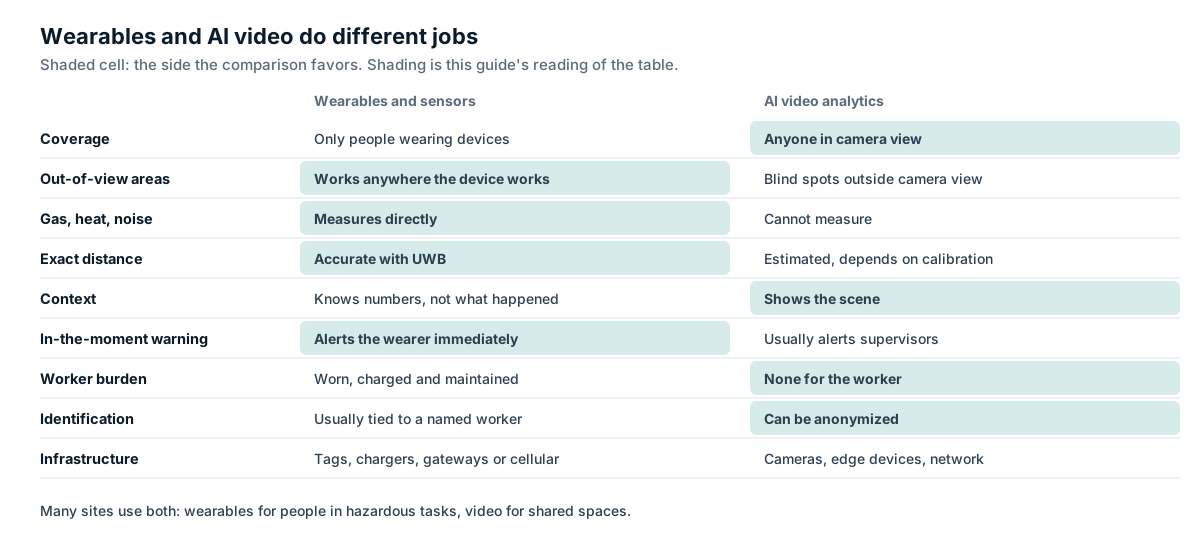
Many sites combine the two. Proximity tags give an immediate warning at the moment of risk. Cameras show why interactions happen, such as a badly placed walkway or a blind corner, which supports engineering changes. Some vendors are moving to combine them directly; Modjoul, for example, describes pairing its SmartBelt with AI vision as well as UWB [8].
What makes wearable programs succeed or fail?
Adoption and compliance
A wearable only works if it is worn. Common failure points include discomfort, interference with PPE or tool belts, devices left in vehicles or lockers, batteries not charged between shifts, and workers who simply do not trust what the device is for. Programs that succeed usually involve workers in choosing devices, explain clearly what data is collected and who sees it, and make charging and distribution part of the shift routine.
Alert design
A device that vibrates for every bend teaches people to ignore vibration. Vendors tune thresholds to the task, and some programs start with a period of silent data collection before turning on feedback, so thresholds reflect real work rather than default settings.
Maintenance and calibration
Gas detectors need regular bump testing and calibration. Proximity tags need batteries and firmware updates. Location systems need anchors or gateways that stay powered and in position. Connected platforms help here, because many record calibration status and device health centrally, but someone still has to act on the records.
Data use
Connected wearables help only if someone uses the data. Gas alarm histories show where leaks recur. Proximity events show which intersections need redesign. Ergonomic data shows which tasks drive strain and should be re-engineered. If data is used only to rank or discipline individuals, workers are less likely to wear the devices, and the program loses both trust and coverage.
What privacy and legal issues apply to wearables?
Wearables generally collect more personal data than camera systems, because they are linked to a named person and record that person continuously.
Under the EU and UK GDPR, location and movement data about an identifiable worker is personal data. Heart rate, body temperature and other physiological measures can be data concerning health, which falls into the special categories of personal data that require an additional legal condition for processing under Article 9 [24]. The UK Information Commissioner's Office (ICO) guidance on monitoring workers covers automated monitoring, transparency and when a data protection impact assessment is needed [21].
In the United States, Illinois' Biometric Information Privacy Act (BIPA), enacted in 2008, requires consent before collecting certain biometric identifiers and allows individuals to sue for $1,000 per negligent violation and $5,000 per intentional or reckless violation [20]. Most safety wearables do not collect biometric identifiers in the BIPA sense, such as fingerprints or face geometry, but devices that use biometric login or identity verification may.
In the EU, the AI Act has prohibited AI systems that infer emotions in the workplace since 2 February 2025, with exceptions for medical or safety reasons [22]. Wearables that interpret physiological signals, such as stress or fatigue indicators, should be checked against this prohibition, and buyers should confirm with vendors and legal advisers how a safety exception applies to their use.
Chapter 13 covers these laws, worker consultation and union agreements in more depth.
What should buyers ask wearable vendors?
- What exactly does the device measure, and how was each measurement validated? Ask for published or independent studies, not only internal data.
- What alert thresholds are used by default, and how are they tuned for different tasks?
- What is the battery life in real shifts, and what charging infrastructure is needed?
- How does the system detect that a worker is not wearing the device?
- What connectivity is required: cellular, satellite, Wi-Fi, or site gateways?
- Where is data stored, who can see individual-level data, and how long is it retained?
- Can individual data be aggregated or pseudonymized for reports?
- How do outcome figures in marketing materials compare with the customer's own baseline, and was there a control group?
- What integrations exist with EHS software, as covered in Chapter 7?
Summary
Safety wearables and sensors measure hazards directly: gas, heat strain, noise, posture and the distance between people and vehicles. Connected gas detection and lone worker devices are the most established category and support clear regulatory duties such as confined space atmospheric testing. Heat stress monitors and ergonomic wearables are growing, supported by research showing sensors can validly measure physiological status and movement, although long-term injury outcomes are less well studied.
Proximity warning systems using UWB, BLE, RFID or radar provide in-the-moment warnings that video analytics usually cannot. Research since NIOSH's 2006 evaluation shows that detection itself works and that nuisance alarms are the main risk to effectiveness.
Wearables and AI video complement each other: wearables protect the individual wherever they are and measure what cameras cannot, while video covers everyone in view and shows context. Wearables also collect more identifiable and sometimes health-related data, so privacy design, worker involvement and clear data use rules decide whether a program is accepted and sustained.
Frequently asked questions
+Are wearables or cameras better for workplace safety?
They solve different problems. Cameras cover an area without anyone wearing anything, but they only see what is in view and cannot measure gas, heat strain or exact distances. Wearables measure the individual directly and work out of camera view, but only for people who wear them, charge them and keep them on. Many sites use both.
+Do forklift proximity warning systems stop collisions?
They can reduce the chance of a collision by warning drivers and pedestrians, and some systems can slow a vehicle automatically. They depend on everyone wearing tags and on alerts being trusted. If alarms are frequent for situations that are not dangerous, people learn to ignore them.
+Do ergonomic wearables reduce injuries?
Vendors such as StrongArm report injury reductions among their customers, but those figures are self-reported. Peer-reviewed reviews show wearable sensors are valid for measuring posture and movement, while long-term injury outcomes in real workplaces remain less studied.
+Is wearable data covered by privacy law?
Often, yes. Location and movement data about identifiable workers is personal data under GDPR and UK GDPR, and heart rate or body temperature can be health data, which has stricter rules. In Illinois, the Biometric Information Privacy Act applies to certain biometric identifiers. Get legal advice before deployment.
Related reading
Sources
- [1]Blackline Safety (company website)
- [2]29 CFR 1910.146 Permit-required confined spaces (OSHA)
- [3]29 CFR 1910.95 Occupational noise exposure (OSHA)
- [4]SlateSafety (company website)
- [5]Heat Injury and Illness Prevention rulemaking (OSHA)
- [6]StrongArm Technologies (company website)
- [7]Kinetic (company website)
- [8]Modjoul (company website)
- [9]HaloGuard (Modjoul)
- [10]Litum (company website)
- [11]Invixium (company website)
- [12]Ruff, Evaluation of a radar-based proximity warning system for off-highway dump trucks, Accident Analysis and Prevention (2006)
- [13]Baek and Choi, Smart Glasses-Based Personnel Proximity Warning System for Improving Pedestrian Safety in Construction and Mining Sites, IJERPH (2020)
- [14]Mastrolembo Ventura et al., Enhancing Safety on Construction Sites: A UWB-Based Proximity Warning System Ensuring GDPR Compliance, Sensors (2023)
- [15]Motta et al., The Use of Wearable Systems for Assessing Work-Related Risks Related to the Musculoskeletal System: A Systematic Review, IJERPH (2024)
- [16]Donisi et al., Wearable Sensors and Artificial Intelligence for Physical Ergonomics: A Systematic Review of Literature, Diagnostics (2022)
- [17]Bustos et al., Applicability of Physiological Monitoring Systems within Occupational Groups: A Systematic Review, Sensors (2021)
- [18]Bär et al., The influence of using exoskeletons during occupational tasks on acute physical stress and strain: a systematic review and meta-analysis, Applied Ergonomics (2021)
- [19]Protect lone workers: employer guidance (HSE)
- [20]Biometric Information Privacy Act (Wikipedia)
- [21]Employment practices and data protection: monitoring workers (ICO)
- [22]Timeline for the implementation of the EU AI Act (AI Act Service Desk, European Commission)
- [23]Powered Industrial Trucks eTool: Pedestrian Traffic (OSHA)
- [24]Regulation (EU) 2016/679, General Data Protection Regulation (EUR-Lex)
- [25]Kinetic retires wearables from workers' comp program (Coverager, September 30, 2026)
New chapters and updates, once a month
One email when we publish or update guidance. No vendor promotions. Unsubscribe any time.