Part 3: Industries · Chapter 9
Warehousing, Distribution and Logistics
Warehouse safety in 2026: BLS, HSE and EU injury data, forklift and loading dock hazards, OSHA 1910.178 and the warehousing NEP, and how AI video is used.
By LIPAI WANG · Updated · 20 min read · 22 sources · 1 figure
Warehouses and distribution centers combine forklifts, people on foot, high racking, loading docks and fast, repetitive manual work, and they have injury rates well above the average for private industry. This chapter sets out the injury data from BLS, HSE and Eurostat, the hazards behind it, the main rules (including OSHA's powered industrial truck standard and its warehousing emphasis program), and how operators are using AI video, proximity warning, telematics and automation. It ends with the questions buyers should ask before a pilot.
How dangerous is warehouse work? What the data shows
United States
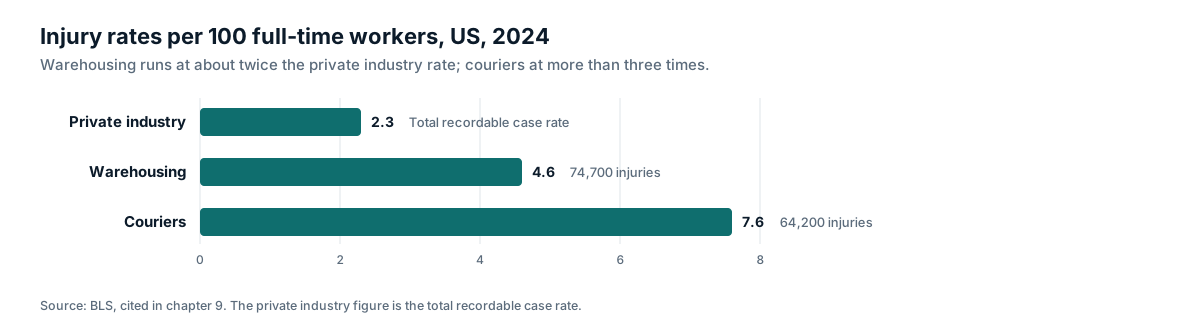
BLS reported 74,700 nonfatal injuries in warehousing and storage in 2024, a rate of 4.6 cases per 100 full-time workers [1]. Couriers and messengers, which includes parcel delivery and many sortation hubs, had 64,200 injuries at 7.6 per 100 [1]. For comparison, the total recordable case rate across all of private industry in 2024 was 2.3 per 100, the lowest in the series going back to 2003 [2]. Warehousing therefore runs at about twice the private industry average, and courier operations at more than three times.
On fatalities, the BLS Census of Fatal Occupational Injuries counted 5,070 worker deaths in 2024 [3]. Transportation and material moving occupations, which include forklift operators, material handlers and laborers, recorded 1,391 deaths, the most of any occupational group, at 12.5 per 100,000 full-time equivalent workers [3]. Pedestrian incidents involving motorized land vehicles rose 19% to 369 [3]. Most of those happen on roads, but the trend is relevant for yards, docks and trailer areas where trucks and people mix.
Forklifts deserve separate attention. A BLS fact sheet counted 614 workers killed in forklift-related incidents from 2011 to 2017, and 74 deaths in 2017 alone [4]. In 2017 the leading fatal events were nonroadway incidents (20), a category that includes off-road events such as tip-overs on site, being struck by a powered vehicle (13), being struck by falling objects (12), falls to a lower level (11) and pedestrian vehicular incidents (9) [4]. Forklifts were also involved in 9,050 nonfatal injuries with days away from work in 2017, with a median of 13 days away compared with 8 days for all cases [4]. Pedestrians struck by forklifts had a median of 20 days away from work, the most severe category [4]. BLS changed its injury classification system starting with 2023 data, so newer figures should not be compared directly with these.
Great Britain
HSE reported 126 worker deaths in Great Britain in 2025/26 (provisional) [10]. Averaged over 2021/22 to 2025/26, being struck by a moving vehicle caused around 17% of all worker deaths, but around 30% of deaths in transportation and storage [10]. HSE says transportation and storage has a fatal injury rate around 1.5 to 2.5 times the all-industry average [10]. Warehousing activity also sits in wholesale and retail, which HSE describes as relatively low risk at sector level while noting that risk varies across activities within it [10].
European Union
Eurostat reported 3,298 fatal and 2.83 million non-fatal accidents at work in the EU in 2023, with a fatal rate of 1.63 per 100,000 employed people [14]. In transportation and storage, 58.5% of fatal accidents happened in public areas, mainly roads [15]. That means the in-warehouse share is smaller, and operators need company or national data to benchmark warehouse floors specifically.
Summary of headline figures
| Measure | Figure | Year | Source |
|---|---|---|---|
| US warehousing and storage nonfatal injury rate | 4.6 per 100 FTE (74,700 cases) | 2024 | BLS [1] |
| US couriers and messengers nonfatal injury rate | 7.6 per 100 FTE (64,200 cases) | 2024 | BLS [1] |
| US private industry total recordable case rate | 2.3 per 100 FTE | 2024 | BLS [2] |
| US transportation and material moving occupation deaths | 1,391 (12.5 per 100,000) | 2024 | BLS [3] |
| US forklift-related deaths | 614 total | 2011 to 2017 | BLS [4] |
| GB share of transportation and storage deaths from moving vehicles | around 30% | 2021/22 to 2025/26 average | HSE [10] |
| EU fatal accidents at work, all sectors | 3,298 (1.63 per 100,000) | 2023 | Eurostat [14] |
What are the main hazards in warehouses and distribution centers?
Forklifts and other powered industrial trucks
"Powered industrial trucks" is OSHA's term for forklifts, reach trucks, order pickers, pallet jacks and similar machines [6]. OSHA notes that different types carry different risks; for example, a sit-down counterbalanced high-lift truck is more likely than a motorized hand truck to be involved in a falling load accident [6]. The main hazards are tip-overs, falling loads, collisions with racking and other vehicles, falls from forks or elevated pallets, trucks driven off loading docks, and pedestrians being struck [4][6].
Poor visibility runs through most of these. A loaded forklift often blocks the driver's forward view, so many drivers travel in reverse. Racking ends and doorways create blind corners. OSHA's standard requires drivers to "slow down and sound the horn at cross aisles" and other places where vision is obstructed [5].
Pedestrian and vehicle interaction
Pick and pack operations put large numbers of people on foot in the same aisles as trucks. HSE workplace transport guidance organizes controls into safe site, safe vehicle and safe driver, with segregation of people and vehicles as part of safe site design [13]. Painted walkways help, but physical barriers, one-way systems, pedestrian-only zones and timed separation (for example, no replenishment in a pick aisle while pickers are in it) are stronger controls. The BLS finding that pedestrians struck by forklifts lose the most work time [4] is a good reason to put this hazard first in any technology plan.
Loading docks and trailers
Docks combine forklifts, trailers, dock levelers and drivers, often under time pressure. OSHA requires that highway truck brakes be set and wheel chocks placed under the rear wheels while forklifts board them, that railroad cars be secured with wheel stops or equivalent protection, and that fixed jacks may be needed to support uncoupled semitrailers [5]. Common incidents include trailers moving away from the dock while a forklift is inside ("trailer creep" or early departure), forklifts falling off the dock edge, trailer floors failing, and drivers on foot in the yard. Technology here includes vehicle restraints with interlocked lights, dock door sensors, and cameras that check whether a trailer is restrained before a door opens.
Racking, falling objects and work at height
Racking strikes by forklifts can damage uprights and lead to collapse. Falling stock from high bays is another hazard, and order pickers working at height need fall protection. OSHA bars anyone from standing or passing under the elevated portion of any truck, loaded or empty [5].
Manual handling and ergonomics
Musculoskeletal disorders from lifting, twisting and repetitive motion account for a large share of injuries in many fulfillment operations. HSE's warehousing guide HSG76 covers manual handling alongside mechanical handling, site transport and work at height [12]. Productivity targets interact with this risk. In December 2024, the majority staff of the Senate Health, Education, Labor and Pensions (HELP) Committee, chaired by Senator Bernie Sanders, published a report arguing that Amazon's speed and productivity requirements drove high rates of musculoskeletal disorders in its warehouses [16]. Amazon disputed the report and called it "wrong on the facts" [17]. The report brought the link between work pace and injury to the attention of US regulators and legislators.
Heat, slips and housekeeping
Large, unconditioned warehouses can get very hot in summer, and both OSHA and state regulators have focused on heat. Slips and trips from wrapping film, broken pallets and spilled product are frequent, and blocked exits and aisles create fire and egress risks.
Which regulations and guidance apply?
United States: OSHA 1910.178
The general industry standard for powered industrial trucks is 29 CFR 1910.178. Its key operator rules are:
- Employers must ensure that each operator "is competent to operate a powered industrial truck safely," shown through training and evaluation [5].
- Training must combine formal instruction, practical training and evaluation, and must cover truck topics (controls, stability, capacity) and workplace topics including pedestrian traffic and surface conditions [5].
- Each operator's performance must be evaluated "at least once every three years," with refresher training after unsafe operation, an accident or near miss, a failed evaluation, a change of truck type, or a change in workplace conditions [5].
- Drivers must keep about three truck lengths from the truck ahead and slow down and sound the horn at cross aisles and where vision is obstructed [5].
The standard still incorporates the 1969 edition of ANSI B56.1 for the design of new trucks [5]. OSHA proposed in February 2022 to update the references to current ANSI B56 standards, including B56.5 for driverless and automated vehicles [9]. Buyers should check the status of that rulemaking before relying on it.
OSHA's National Emphasis Program on warehousing
OSHA launched a National Emphasis Program (NEP) on warehousing and distribution center operations effective July 13, 2023 [7]. It covered warehousing, mail and postal processing centers, parcel delivery and courier services, and some high injury rate retail stores, with inspections focused on powered industrial vehicle operations, material handling and storage, walking-working surfaces, means of egress and fire protection, plus heat and ergonomics [7]. According to environmental consultancy ALL4, OSHA renewed the program effective July 31, 2026, for five years [8]. ALL4 reports that the renewal removed high injury rate retail establishments from coverage and dropped mandatory screening for heat and ergonomic hazards, although inspectors can still evaluate those hazards [8]. For warehouse operators, an NEP means a higher chance of a programmed inspection and a focus on exactly the hazards this chapter covers.
Great Britain
There is no warehouse-specific regulation in Great Britain. The Health and Safety at Work etc. Act 1974 and general regulations apply, supported by HSE guidance:
- L117, Rider-operated lift trucks: Operator training and safe use (2013), an Approved Code of Practice covering operator training, safe operation, pedestrian protection and thorough examination [11].
- HSG76, Warehousing and storage: A guide to health and safety (2007), written with the Warehousing Health and Safety Forum [12].
- HSG136, A guide to workplace transport safety (third edition, 2014), built around safe site, safe vehicle and safe driver [13].
European Union
EU warehouses work under the occupational safety and health framework directive and national transpositions. Product rules for equipment are changing: the Machinery Regulation (EU) 2023/1230 applies from January 20, 2027, and includes provisions for machinery with AI-powered safety functions and for cyber security of safety-related software [22]. That matters for buyers of autonomous mobile robots, automated forklifts and any system that can stop or slow a machine.
How are warehouses using safety technology?
Warehouses are the most developed market for AI safety analytics. The environment suits cameras: indoor lighting, defined aisles, fixed CCTV and repetitive, rule-based traffic. The main technology groups are below.
AI video analytics on fixed cameras
AI video systems process existing or new CCTV feeds to detect events such as forklift speeding, failure to stop at intersections, pedestrians outside walkways, near misses between people and trucks, missing PPE, blocked exits and aisles, and poor lifting posture. Chapter 4 explains how detection and alerting work, and Chapter 5 covers each use case. The output is usually a dashboard of events with short video clips, used mainly for coaching, layout changes and trend reporting, with real-time intervention less common.
Cameras and sensors on the truck
Vehicle-mounted systems put cameras or sensors on the forklift itself. They can record impacts, detect pedestrians in the truck's path, check that operators wear seatbelts, and measure speed and idle time. Some combine cameras with telematics. Truck-mounted systems cover the whole building wherever the truck goes, but they only see what is in front of or around that truck.
Proximity warning
Proximity systems warn drivers and pedestrians when they are too close. Tag-based systems use radio tags worn by pedestrians and readers on trucks, while tag-free systems use cameras, radar or lidar on the truck. Lights projected on the floor ahead of a truck and audible alarms are simpler warning aids. Chapter 6 compares the options. The usual problems are nuisance alerts in busy aisles, which drivers learn to ignore, and visitors or temporary workers without tags.
Telematics and access control
Forklift telematics record impacts, speed, operating hours and pre-use checklist completion, and can lock a truck to trained operators with a card or PIN. This supports the OSHA requirement that only competent, evaluated operators drive [5], and impact data shows where racking strikes and collisions cluster.
Automation
Autonomous mobile robots, automated guided vehicles, automated storage and retrieval systems and robotic picking remove some people from the most dangerous tasks. They also create new risks at the interface with people: maintenance, clearing jams, mixed traffic zones and software faults. The ANSI B56.5 standard for driverless industrial vehicles [9] and the EU Machinery Regulation [22] are the reference points for that equipment.
Matching technology to warehouse hazards
No single product covers every warehouse hazard, and each technology sits at a different level of the hierarchy of controls (see Chapter 1). Physical segregation and engineering controls such as barriers and dock restraints prevent contact. Most monitoring technology works at the administrative level: it shows where rules are broken so managers can change layouts, retrain people or enforce rules. The table below maps the main hazards to the controls that come first and the technology that can support them.
| Hazard | Controls to put in place first | Technology that can support them | Main limitation |
|---|---|---|---|
| Pedestrian struck by forklift | Physical barriers, pedestrian-only aisles, one-way routes, timed separation | Fixed-camera AI video for walkway breaches and near misses; proximity warning; floor projection lights | Video reports events after the fact unless alerts are real time; tags must be worn |
| Intersection and cross-aisle collisions | Stop lines, mirrors, speed limits, horn rules [5] | AI video for stop and speed violations; telematics speed limiting | Fixed cameras cover only the intersections they can see |
| Trailer creep or early departure at docks | Wheel chocks or vehicle restraints, brakes set, communication between driver and dock [5] | Interlocked restraints and lights; door sensors; cameras checking restraint status | Systems need maintenance and can be bypassed |
| Tip-overs and falling loads | Operator training and evaluation, load capacity checks, floor condition [5] | Telematics impact and tilt data; truck cameras | Data shows events but not the operator's training gaps |
| Racking strikes | Rack protection, aisle width, inspection regime | Telematics impact data; truck cameras | Low-speed impacts may fall below sensor thresholds |
| Manual handling injuries | Job design, lift aids, workstation height, realistic work rates | AI video posture scoring; wearable sensors (Chapter 6) | Scores need ergonomic expertise to act on and can be misused for pace management |
| Blocked exits and aisles | Housekeeping routines, marked storage areas | AI video for obstruction detection | Requires clear camera views of exits |
Two practical points follow. First, technology works best on hazards where the fix is a management action the site is able to take, such as moving a pallet location, adding a barrier or changing a shift pattern. Second, sites should be careful when the same data could measure both safety and output. Ergonomic scoring that ends up being used to push work rates would undermine the purpose of buying it, a concern raised directly in the Senate HELP report [16].
Where AI video struggles in warehouses
Indoor conditions are kinder to cameras than a port, but problems remain. Open dock doors produce strong backlight that hides people in silhouette. High racking blocks lines of sight, so one camera rarely covers a full aisle. Shrink wrap, reflective labels and high-visibility clothing can confuse detectors in ways that differ by site. Night shifts in partly lit areas reduce accuracy. Cold stores add condensation on lenses. Ask vendors how they test for each of these on your footage, and include them in the pilot acceptance criteria.
Public deployment examples
These examples come from vendor publications. The figures are vendor-reported and have not been independently verified. None of the sources publishes a full method, baseline or control group.
Protex AI and DHL
Protex AI, a computer vision safety company, announced in June 2023 that it had worked with DHL Global Forwarding in Denmark [18]. Protex AI describes a proof of concept in which its software, running on existing cameras, monitored forklift speed, use of walkways, PPE and obstructed pathways, and flagged near misses and procedural non-compliance [18]. The announcement does not give quantified results. Protex AI says the data collection was anonymous and GDPR compliant [18].
On its logistics page, Protex AI makes quantified claims for other customers, mostly unnamed. These include an 80% reduction in incidents attributed to Marks & Spencer, and figures for unnamed "top 3" North American food distributors such as a 44% reduction in lost time injury rate with a 74% decrease in near-miss events [19]. Without names, dates and methods, these numbers are difficult to check.
Voxel and Verst Logistics
Voxel publishes a case study on Verst Logistics, a third-party logistics provider, at its warehouse in Hebron, Kentucky [20]. According to Voxel, daily vehicle safety incidents (detected events, not injuries) fell from 19 to 3 in six months, with an 82% drop in vehicle safety incidents, a 92% drop in "no stop at intersection" events and a 50% drop in ergonomic incidents in five months [20]. Voxel attributes the change to video-based coaching of forklift drivers, extra stop signs, driver retraining and marked no-pallet zones to keep pedestrian paths clear [20]. By Voxel's own account, then, the improvement depended on what managers did with the data.
OneTrack
OneTrack, founded in 2017 and based in Chicago, makes cameras and AI sensors mounted on forklifts and yard trucks as well as fixed locations [21]. The company names CJ Logistics as a customer and claims, for that customer, 45% less gap time and 18% more units per hour [21]. Those are productivity figures, and OneTrack sells safety and operations data together. OneTrack also cites a 93% reduction in safety incidents as an "industry" metric without naming a customer [21].
What the examples show
Published warehouse results almost always measure detected events, such as speeding, stop violations or walkway breaches, over a few months. Detected events depend on camera coverage and detection settings, so a fall in events can reflect real behavior change, changed settings or both. Injury results, when reported, are often from unnamed customers. Treat these claims as hypotheses for your own pilot and measure against your own baseline (see Chapter 15).
What should warehouse buyers ask vendors?
Problem fit
- Which incidents and near misses drive our risk today, and which of them can your system see? Pedestrian strikes, intersection collisions, dock incidents and ergonomics need different camera positions.
- Do you recommend fixed cameras, truck-mounted cameras or both for our layout?
- How do you handle high racking, blind corners and docks with strong backlight from open doors?
Accuracy and alert load
- What are your detection and false alert rates on our footage for each event type?
- How many alerts per shift should a supervisor expect, and what do you do to keep that number manageable?
- Do you separate real-time alerts (for imminent danger) from daily reports (for coaching)?
Integration
- Can events flow into our EHS or incident management system and our warehouse management or labor management system?
- Can you combine video with forklift telematics or proximity system data?
- If your system can slow or stop vehicles, which truck makers is it integrated with, and how is that function validated against standards such as ANSI B56 or, in the EU from 2027, the Machinery Regulation [9][22]?
Workers and data
- Does the system identify individuals? Can faces and bodies be blurred or anonymized by default?
- Will event data ever be used for productivity scoring or discipline? If so, under what written rules, agreed with whom?
- How do you prevent safety monitoring from adding to the pace pressure that is itself a risk factor [16]?
- What data protection documentation do you provide for GDPR or UK GDPR, and how do you support US state privacy rules (see Chapter 13)?
Evidence and commercial terms
- Can we speak to named warehouse customers who have used the product for more than a year?
- For each published result, what was the baseline, which metric changed, and what else changed at the site?
- Will you commit in writing to pilot acceptance criteria, including detection and false alert targets, before we sign a multi-site agreement?
Summary
US warehousing and storage had a nonfatal injury rate of 4.6 per 100 workers in 2024, about twice the private industry average [1][2], and couriers and messengers were higher still. Forklifts cause a small share of incidents but many of the most severe, with 614 forklift-related deaths in the US from 2011 to 2017 [4]. In Great Britain, being struck by a moving vehicle accounts for around 30% of worker deaths in transportation and storage [10].
The rules focus on competent operators, safe traffic routes and secure docks. OSHA 1910.178 requires training and evaluation at least every three years and specific driving and dock practices [5], and OSHA's warehousing emphasis program, renewed in 2026 according to ALL4, keeps inspectors focused on powered industrial vehicles and material handling [8]. In Great Britain, L117, HSG76 and HSG136 set out the expected practice [11][12][13].
Warehouses are the most active market for AI video, truck cameras, proximity warning and telematics. Public examples from Protex AI, Voxel and OneTrack show the kinds of events these systems detect and the results vendors report, mostly as reductions in detected unsafe events. Those claims can justify a pilot. They are too thin to support a business case on their own. The sites that report the best outcomes acted on the data with layout changes, coaching and retraining, and they set clear rules on how monitoring data would and would not be used.
Frequently asked questions
+Is AI video monitoring in a warehouse legal?
In most jurisdictions it can be, but the rules differ. In the UK and EU, data protection law usually requires a documented purpose, a data protection impact assessment and transparency with workers. In the US, some states regulate workplace monitoring or warehouse quotas. Chapter 13 covers the details, and you should take legal advice for each site.
+Do forklift cameras and proximity sensors meet OSHA requirements?
OSHA's powered industrial truck standard focuses on operator training, evaluation and safe operation, and it does not require camera or sensor systems. These technologies can support compliance by showing where rules are broken, but trained operators, traffic management and maintenance are still required.
+How quickly should a warehouse see results from AI video?
Vendors often report changes in observed behavior, such as speeding or walkway violations, within weeks to months. Injury rates take longer to move and are noisy at a single site. Set behavior targets for the pilot and track recordable and lost-time injuries over at least a year before drawing conclusions.
+Should we start with fixed cameras or forklift-mounted cameras?
Fixed cameras give an overview of aisles, intersections and docks and can often reuse existing CCTV. Truck-mounted cameras see what the driver sees and record impacts anywhere in the building. Many sites start with the problem that drives most incidents, often intersections or docks, and pick the camera type that covers it.
Related reading
Sources
- [1]Number and rate of nonfatal work injuries in detailed private industries, 2024 (BLS)
- [2]Employer-Reported Workplace Injuries and Illnesses, 2024 (BLS, January 22, 2026)
- [3]National Census of Fatal Occupational Injuries in 2024 (BLS)
- [4]Fatal and nonfatal occupational injuries involving forklifts, 2011-17 (BLS fact sheet)
- [5]29 CFR 1910.178 Powered industrial trucks (OSHA)
- [6]Powered Industrial Trucks (OSHA safety topic)
- [7]CPL 03-00-026 National Emphasis Program on Warehousing and Distribution Center Operations, 2023 (OSHA)
- [8]OSHA Renews National Emphasis Program for Warehousing and Distribution Center Operations (ALL4)
- [9]Powered Industrial Trucks Design Standard Update, proposed rule (Federal Register, February 16, 2022)
- [10]Work-related fatal injuries in Great Britain, 2026 (HSE)
- [11]Rider-operated lift trucks: Operator training and safe use, L117 (HSE)
- [12]Warehousing and storage: A guide to health and safety, HSG76 (HSE)
- [13]A guide to workplace transport safety, HSG136 (HSE)
- [14]Accidents at work claimed 3 298 lives in the EU in 2023 (Eurostat)
- [15]25% of fatal work accidents happened in public areas (Eurostat)
- [16]The Injury-Productivity Trade-off: How Amazon's Obsession with Speed Creates Uniquely Dangerous Warehouses (Senate HELP Committee majority staff, December 2024)
- [17]Senate probe rips Amazon over warehouse worker injuries; company calls it 'wrong on the facts' (GeekWire)
- [18]DHL Partners with Protex AI for AI-Powered Logistics Safety Solutions (Protex AI)
- [19]Logistics and Supply Chain AI Safety (Protex AI)
- [20]Verst Logistics customer story (Voxel)
- [21]About OneTrack (OneTrack)
- [22]Machinery: Regulation (EU) 2023/1230 (European Commission)
New chapters and updates, once a month
One email when we publish or update guidance. No vendor promotions. Unsubscribe any time.