Part 5: The future · Chapter 17
Safety Technology Outlook to 2030: Regulation, Insurance, Markets and the Workforce
Outlook to 2030 for workplace safety technology: EU AI Act and machinery rules, OSHA heat rulemaking, insurance trends, funding signals, skills and three scenarios.
By LIPAI WANG · Updated · 20 min read · 26 sources · 1 figure
Our outlook is that, between now and 2030, four outside forces will shape workplace safety technology more than new inventions will: regulation of AI and machinery, the economics of insurance and injury costs, the flow of investment into vendors, and the skills of the people who buy and run these systems. This chapter sets out what is already fixed, what is likely and what is uncertain, and ends with three scenarios marked as outlook.
Dates and figures are current as of October 2026, and forward-looking statements are labeled as outlook. Regulatory timetables have slipped several times in the past two years, so treat every future date as subject to change.
What is the starting point in 2026?
In the United States, the Bureau of Labor Statistics (BLS) recorded 5,070 fatal work injuries in 2024, down 4.0 percent from 5,283 in 2023, for a rate of 3.3 deaths per 100,000 full-time equivalent workers [17]. That works out to one worker death every 104 minutes. Transportation incidents remained the most frequent fatal event, accounting for 38.2 percent of deaths [17]. The 2024 figures were published in February 2026, two months late because of the fall 2025 federal government shutdown.
Globally, the International Labour Organization (ILO) estimates that about 2.93 million workers died from work-related causes in 2019, most of them from work-related disease rather than accidents, and that more than 395 million workers suffered a non-fatal work injury [18].
On cost, the 2025 Liberty Mutual Workplace Safety Index estimated that serious workplace injuries cost US employers $58.7 billion a year, with the top 10 causes accounting for $50.87 billion. Overexertion involving outside sources led at $13.7 billion, followed by falls on the same level at $10.5 billion [11]. The index uses 2022 data. Liberty Mutual also noted that the rate of serious workplace accidents fell by about 40 percent over the index's 25 years while workers' compensation costs rose by about 30 percent [11].
On technology, the previous chapters showed AI video analytics in production at many large sites, a crowded EHS software market adding generative AI features, and early commercial deployments of humanoids, autonomous terminal tractors and docked drones.
How will regulation shape safety technology to 2030?
Which EU AI Act dates matter for safety technology?
The EU AI Act is the most important single regulation for AI used at work in Europe, and its timetable changed in 2026.
Some parts already apply. Since February 2, 2025, the Act has prohibited certain practices, including AI systems that infer the emotions of people in the workplace. The European Commission's guidelines on prohibited practices explain that the ban covers inferring workers' emotions from biometric data and that systems used for medical or safety reasons, such as detecting fatigue in pilots or drivers, are exempt [3]. Safety technology buyers should check that no feature of a product infers mood, stress or emotion from faces or voices unless it clearly falls under the safety exception.
The obligations for high-risk AI systems were originally due on August 2, 2026. In 2026 the EU adopted a "Digital Omnibus" package that moved them. According to Gibson Dunn's summary of the political agreement, obligations for stand-alone Annex III high-risk systems now apply from December 2, 2027, and obligations for AI embedded in products regulated under Annex I apply from August 2, 2028 [1]. Usercentrics reports that the amending regulation entered into force on July 27, 2026, three days after publication in the Official Journal, and confirms the new dates [2]. The same agreement softened the general AI literacy duty, so that providers and deployers must support the development of AI literacy among staff rather than ensure a specified level [1].
For safety technology, two parts of the Act matter most. Annex III includes AI used in employment to monitor and evaluate the behavior and performance of workers, which can capture some uses of video analytics and wearables. Annex I covers AI that is a safety component of products regulated under EU product law, including machinery. Whether a particular system is high risk depends on its purpose and design, so this is a legal question for each deployment.
Outlook: by 2028, expect EU buyers to ask vendors routinely for AI Act conformity documentation, risk management records and human oversight designs. Vendors that cannot provide them will struggle in European tenders.
What changes with the EU Machinery Regulation in 2027?
The Machinery Regulation (EU) 2023/1230 replaces the Machinery Directive and applies in full from January 20, 2027, with no further transition period [5]. It brings new requirements on cybersecurity and on autonomous and AI-based machinery, and it names safety components with self-evolving behavior using machine learning as a high-risk category [5].
This matters for robots, autonomous vehicles in yards and terminals, and any machine whose safety function depends on AI. FERNRIDE's 2025 certification by TÜV SÜD was issued under the old Machinery Directive [24]; equipment placed on the EU market from 2027 must meet the new regulation. Buyers should ask suppliers how their products will be assessed under it, and whether products bought before 2027 will remain supported.
According to the Association for Advancing Automation (A3), the revised robot safety standard ISO 10218, published in February 2025, gives manufacturers and integrators clearer functional safety requirements for industrial robots and collaborative applications [20].
How will rules on algorithmic management affect safety monitoring?
The EU Platform Work Directive (Directive (EU) 2024/2831) must be transposed by member states by December 2, 2026 [4]. It is aimed at digital labor platforms, but it sets transparency and human oversight rules for automated monitoring and decision-making systems that affect working conditions [4]. Combined with GDPR and the AI Act, it reinforces a direction already visible in Chapter 13: employers must tell workers what monitoring systems do, keep a human responsible for significant decisions and give workers a way to challenge outcomes.
Outlook: by 2030, expect European works councils and unions to treat AI safety monitoring as a standard subject for consultation, with written agreements on what data is collected, who sees it and whether it can be used for discipline.
What is happening in US federal safety regulation?
US federal safety rulemaking has moved slowly in recent years.
OSHA published a proposed standard for Heat Injury and Illness Prevention in Outdoor and Indoor Work Settings in 2024 [6]. The proposal would set an initial heat trigger at a heat index of 80°F and a high heat trigger at 90°F, with extra requirements such as paid rest breaks at the higher level. OSHA held informal public hearings that ended in July 2025 and closed the post-hearing comment period on October 30, 2025, but as of April 2026 it had not issued a final rule [7]. In April 2026 OSHA replaced its 2022 heat National Emphasis Program with a revised five-year program that narrowed the list of targeted industries and dropped numeric inspection goals [7].
For drones, the FAA's proposed Part 108 rule for beyond-visual-line-of-sight operations was published in August 2025 [9]. A status guide from the drone training organization USI reported that the final rule went to White House review in July 2026 and had not been published by mid-September 2026 [10].
Outlook: through 2030, federal rules will probably arrive late and in modest form. Heat is the most likely new federal standard, but timing is uncertain. Many employers will be driven more by state rules, OSHA enforcement programs and insurer requirements than by new federal standards.
What about US state AI and privacy laws?
State laws are the more active front for AI in employment, and they also change. Colorado passed a broad AI Act in 2024 aimed at high-risk automated decisions, including employment decisions, and in August 2025 postponed its start from February 1, 2026 to June 30, 2026 [8]. In May 2026 the state repealed and replaced that law with SB 26-189, a narrower framework for automated decision-making technology that relies on notice and disclosure and takes effect on January 1, 2027; it still covers employment decisions [26]. Other states have proposed or passed laws on automated decision systems, workplace surveillance and biometric data.
Outlook: expect a patchwork of state rules rather than one federal AI law. Multi-state employers will find it easier to set one high internal standard (notice, purpose limits, human review, data minimization) than to tailor each deployment to each state.
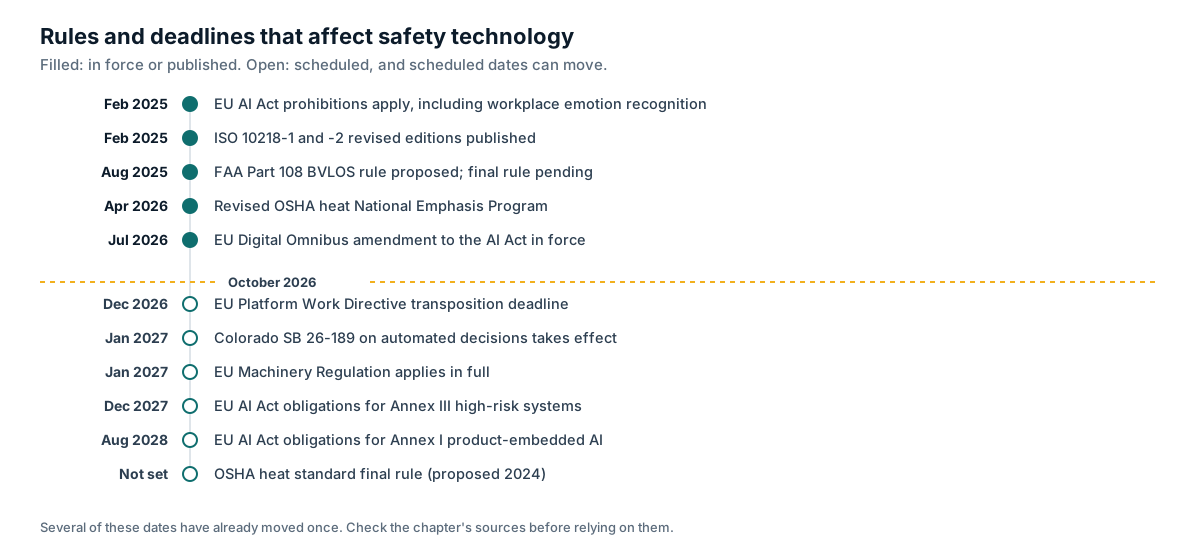
Regulatory timeline at a glance
| Date | Event | Status |
|---|---|---|
| Feb 2, 2025 | EU AI Act prohibitions apply, including workplace emotion recognition | In force [3] |
| Feb 2025 | ISO 10218-1 and -2 revised editions published | Published [20] |
| Aug 7, 2025 | FAA Part 108 BVLOS proposed rule published | Final rule pending [9][10] |
| Apr 10, 2026 | Revised OSHA heat National Emphasis Program | In force for five years [7] |
| Jul 27, 2026 | EU Digital Omnibus amendment to the AI Act enters into force | In force [2] |
| Dec 2, 2026 | EU Platform Work Directive transposition deadline | Set by the directive [4] |
| Jan 1, 2027 | Colorado SB 26-189 on automated decision-making takes effect | Enacted May 2026 [26] |
| Jan 20, 2027 | EU Machinery Regulation applies in full | Fixed [5] |
| Dec 2, 2027 | EU AI Act obligations for Annex III high-risk systems | Set by the Digital Omnibus [1][2] |
| Aug 2, 2028 | EU AI Act obligations for Annex I product-embedded AI | Set by the Digital Omnibus [1][2] |
| Not set | OSHA heat standard final rule | Proposed 2024, not final [7] |
How will insurance and risk transfer change?
What do workers' compensation trends show?
The US workers' compensation market is profitable and claim frequency keeps falling. The National Council on Compensation Insurance (NCCI) reported a calendar-year 2025 combined ratio of 91 percent for private carriers, the 12th consecutive year of underwriting profit [12]. Lost-time claim frequency fell 2 percent in 2025, a slower decline than the long-term average, while medical and indemnity severity each rose 4 percent [12].
Fewer claims at higher cost per claim matches Liberty Mutual's finding that serious accident rates fell over 25 years while total costs rose [11]. Two things follow for safety technology. Insurers care most about the severe claims that drive cost, which points toward SIF prevention, vehicle-pedestrian separation and manual handling. And as frequency falls, a single site has fewer events to measure, which makes it harder to prove that any one control changed outcomes (see Chapter 15).
Are insurers investing in safety technology?
Some are. Voxel's $44 million Series B in June 2025 included Tokio Marine among its investors, alongside the industrial equipment maker Rite-Hite [13]. Insurers and brokers have also run risk engineering programs that recommend or subsidize wearables, telematics and sensors for clients for many years.
An insurer's investment in a vendor does not translate into underwriting credit for that vendor's customers. A premium reflects your loss history, industry class and the insurer's judgment of your controls. A technology may support a better risk profile over time, but buyers should not build a business case on an assumed discount unless their insurer has put it in writing.
What might change in risk transfer by 2030?
Outlook. Several developments are plausible:
- Data-sharing arrangements in which employers share anonymized leading-indicator data, such as near-miss rates or vehicle interaction counts, with insurers in exchange for risk engineering support or pricing input.
- More use of loss-control conditions in policies for high-hazard operations, such as requirements for proximity detection on mobile plant.
- New liability questions for autonomous machines. When a driverless terminal tractor or a humanoid robot is involved in an injury, the allocation of liability among the operator, the manufacturer, the software supplier and the integrator will be tested in contracts and, eventually, courts.
- Insurer interest in AI governance itself. As AI systems take on safety functions, underwriters may ask how they are validated, monitored and overridden.
Buyers should involve their broker and insurer early in any major safety technology project, both to learn what data the insurer values and to check whether the technology changes the liability position.
What do funding and market signals say?
How has investment in AI safety vendors changed?
Venture funding for AI video safety analytics has moved from seed and Series A rounds to larger later-stage rounds. Recent publicly announced examples:
| Company | Round | Amount | Date | Lead investor (as announced) |
|---|---|---|---|---|
| Intenseye | Series B | $64M | February 2024 | Lightspeed Venture Partners [15] |
| Outrider (autonomous yards) | Series D | $62M | Late 2024 | Koch Disruptive Technologies and NEA [16] |
| Protex AI | Series B | $36M | Early 2025 | Hedosophia [14] |
| Voxel | Series B | $44M | June 2025 | NewRoad Capital Partners [13] |
These rounds are large for a niche that was very small a decade ago, but small compared with the broader robotics and physical AI sector, where humanoid developers have raised far larger amounts. Large enterprise customers such as GXO and BMW are running humanoid and robot programs in partnership with well-funded developers [23][25].
What does this suggest about the market by 2030?
Outlook. Several patterns are likely:
- Consolidation. With several venture-backed AI video safety vendors competing for the same enterprise customers, some will merge, be acquired by EHS software companies, camera and video management system makers or industrial technology groups, or close.
- Platform convergence. EHS software vendors are adding AI agents and analytics, as Cority did with Cortex AI in December 2025 [21], while video analytics vendors are adding incident and action management. Expect overlap to grow and buyers to ask which platform is the system of record.
- Cheaper edge compute. Hardware such as NVIDIA's Jetson Thor, available from August 2025 [22], makes it practical to run larger models on site. That lowers the barrier for new entrants and for in-house builds by large employers.
- Pressure for evidence. As budgets tighten and the novelty fades, buyers and insurers will ask for independent outcome data rather than vendor case studies.
For buyers, consolidation is a contract risk. Ask about data portability, escrow of critical software and what happens to service if the vendor is acquired.
How will the safety workforce and skills change?
Will there be enough safety professionals?
BLS projects employment of occupational health and safety specialists to grow from 131,900 in 2024 to 148,400 in 2034, about 12.5 percent, faster than average, with roughly 14,900 openings a year [19]. BLS cites new technologies such as robotics, which need updated safety practices, and the need to protect workers from natural hazards such as excessive heat among the reasons [19].
What new skills will safety teams need?
Outlook. The core of the job does not change: hazard identification, risk assessment, controls, investigation, training and compliance. Around that core, several skills become more important.
| Skill | Why it matters by 2030 |
|---|---|
| Data literacy | Reading dashboards, questioning metrics, understanding precision and recall, spotting bias in data |
| Technology evaluation | Designing pilots, setting acceptance criteria, running fair vendor comparisons |
| AI and privacy regulation | Working with legal teams on DPIAs, AI Act classification and worker notices |
| Machinery and robotics safety | Applying ISO 10218 and the EU Machinery Regulation to robots and autonomous vehicles |
| Change management | Explaining monitoring to workers, involving unions and works councils, building trust |
| Vendor and contract management | Service levels, data ownership, support lifecycles |
Many safety teams will not hire data scientists. More often, they will work with internal IT, data and legal colleagues, and with vendors. The safety professional's job is to frame the right question, judge whether the evidence answers it and keep the focus on reducing harm.
How will frontline jobs change?
Outlook. Some hazardous tasks will be automated: yard driving, some forklift moves, inspection rounds in hazardous areas, repetitive lifting. New roles will appear in remote operation, robot supervision, maintenance and exception handling. Those roles carry their own risks, including fatigue and attention problems in remote monitoring, and hazards during maintenance and recovery of stalled machines.
During the transition, many sites will run mixed operations where people and autonomous machines share space. Mixed operation is where new incident patterns are likely to appear. Traffic management plans, training and incident reporting categories need updating to capture them.
Worker trust remains the deciding factor for monitoring technologies. Workers who believe cameras and wearables are used for discipline rather than safety will resist or work around them. Regulation in Europe is pushing toward consultation and transparency; employers elsewhere have practical reasons to adopt the same approach.
What could safety technology look like in 2030? Three scenarios
The scenarios below are outlook, not forecasts, and real outcomes will probably mix elements of all three. They are meant to help safety and operations leaders test their plans against different futures.
Scenario 1: Steady integration
Regulatory dates hold. EU AI Act high-risk obligations apply from December 2027 for Annex III systems and August 2028 for Annex I products, the Machinery Regulation from January 2027 and the FAA's Part 108 rule takes effect. AI video analytics becomes a normal feature of video management systems and EHS platforms, and many large sites run it the way they run fire detection. Vision-language models are mainly used for search, alert verification and report drafting. Humanoids remain in narrow, segregated roles. Autonomous yard and terminal vehicles expand at large logistics hubs and ports.
What it means for buyers: focus on integration, governance and measured outcomes. Vendor choice matters less than how well the tools fit into incident management, training and daily supervision.
Scenario 2: Fast physical automation
Robot and autonomous vehicle costs fall faster than expected, edge computers become cheap enough for wide deployment, and labor shortages push operators to automate yards, docks and inspection rounds quickly. Many of the most dangerous tasks in logistics and terminals are done by machines by 2030.
What it means for buyers: the biggest safety risks shift to the boundary between people and machines and to maintenance, recovery and remote operation. Safety teams need strong machinery safety expertise and new incident categories. Liability allocation in contracts becomes a central procurement issue.
Scenario 3: Trust and regulatory pushback
A high-profile misuse of workplace monitoring data, a serious incident involving an autonomous machine or a major privacy enforcement case triggers stricter rules and worker resistance. Some jurisdictions restrict continuous video analytics or biometric processing at work. Unions negotiate tight limits on data use.
What it means for buyers: privacy-preserving designs (on-site processing, anonymization, aggregate reporting, no individual discipline from AI outputs) become baseline requirements. Employers that already built trust through consultation and transparency keep their programs; others pause or remove systems.
Signals to watch
| Signal | Points toward |
|---|---|
| EU AI Act dates hold through 2027 and harmonized standards are published | Scenario 1 |
| Publication and take-up of FAA Part 108 | Scenarios 1 and 2 |
| Falling prices and rising unit volumes for humanoids and autonomous yard vehicles | Scenario 2 |
| Published independent outcome studies for AI safety analytics | Scenario 1 |
| Major enforcement action on workplace monitoring or a notable autonomous machine incident | Scenario 3 |
| Insurer data-sharing programs and policy conditions tied to technology | Scenarios 1 and 2 |
| Vendor consolidation and acquisitions by EHS or video platform companies | Scenario 1 |
How should safety leaders plan for 2030?
Several actions make sense under all three scenarios.
Build on the hierarchy of controls. Technologies that eliminate exposure or engineer it out will hold value whatever happens to regulation. Analytics and copilots support people and cannot stand in for physical controls.
Design for privacy and oversight now. On-site processing, data minimization, clear purpose statements, human review of significant decisions, logging and worker consultation are required or expected under the EU AI Act, GDPR, the Platform Work Directive and many state laws. Building them in early avoids costly redesign.
Insist on evidence. Ask vendors for independently measured results, define success before pilots and measure outcomes honestly (Chapter 15). As claim frequency falls, focus measurement on leading indicators linked to serious injury potential.
Plan for mixed operations. If robots or autonomous vehicles are on your roadmap, update traffic management, emergency procedures and incident categories before they arrive.
Protect yourself contractually. Data ownership, portability, support lifecycles, model update practices and liability allocation all matter more in a consolidating market with new kinds of machines.
Invest in people. Safety teams need data, technology and regulatory skills, and frontline workers need a voice in how monitoring and automation are used.
Revisit the plan yearly. The past two years saw the EU AI Act's high-risk dates move, US federal deadlines missed and new product categories reach the market. A plan written in 2026 will need updating in 2027.
Summary
In our outlook, safety technology through 2030 will be shaped by set regulatory dates in Europe (Platform Work Directive transposition in December 2026, the Machinery Regulation in January 2027, and AI Act high-risk obligations from December 2027 and August 2028), slow and uncertain US federal rulemaking on heat and drones, and a patchwork of state AI laws that can be rewritten before they take effect, as Colorado's was. In insurance, claim frequency keeps falling while severity and cost rise, which concentrates attention on serious injury prevention and on measurable controls. Investment in AI safety vendors has reached later-stage rounds, insurers have begun to invest directly, and consolidation is likely.
BLS expects demand for safety specialists to grow faster than average through 2034, and the skills needed will widen to include data, technology evaluation, AI and privacy regulation and machinery safety for autonomous systems. Three outlook scenarios (steady integration, fast physical automation and a trust-driven pushback) give leaders a way to test their plans. The actions that hold up across all of them are the ones this guide has argued for throughout: controls high on the hierarchy, privacy and human oversight by design, honest measurement and real involvement of the workers whose safety is at stake.
Frequently asked questions
+Will the EU AI Act classify our camera-based safety analytics as high risk?
It depends on use. AI used to monitor and evaluate workers' performance and behavior falls into the employment category of Annex III, and AI safety components of regulated machinery are covered through Annex I. After the Digital Omnibus amendment, which entered into force on July 27, 2026, Annex III obligations apply from December 2, 2027 and Annex I obligations from August 2, 2028. Get legal advice on your specific deployment and keep the DPIA current.
+Will insurers give us a premium discount for installing AI safety technology?
Some insurers support or invest in safety technology, but a discount is not automatic. Premiums follow your loss experience and the insurer's view of your controls, so the stronger case is to show measured reductions in risk exposure and claims over time.
+Should we wait for regulations to settle before buying?
Waiting rarely makes sense if you have a clear, serious risk to control. Choose systems that already support data protection, human oversight, logging and worker transparency, because those requirements appear in nearly every proposed or adopted rule.
+What skills will safety teams need by 2030?
Core safety knowledge stays central. Teams will also need data literacy, the ability to run and evaluate technology pilots, working knowledge of privacy and AI regulation, and change management skills to bring workers along.
Related reading
Sources
- [1]EU AI Act Omnibus Agreement: Postponed High-Risk Deadlines and Other Key Changes (Gibson Dunn)
- [2]EU AI Act Deal: Digital Omnibus Now in Force (Usercentrics)
- [3]EU Commission Publishes Guidelines on the Prohibited AI Practices under the AI Act (Orrick)
- [4]The Platform Work Directive (Mason Hayes & Curran)
- [5]Machinery Regulation (EU) 2023/1230 (TUV NORD)
- [6]OSHA Regulation of Employee Exposure to Heat (Congressional Research Service)
- [7]OSHA Refines Heat Enforcement Strategy While Federal Heat Rule Remains Pending (Beveridge & Diamond)
- [8]Colorado Postpones Implementation of Colorado AI Act, SB 24-205 (Akin)
- [9]FAA Releases Long-Awaited BVLOS Proposed Rule (Pillsbury)
- [10]Get FAA Part 108 Ready: 2026 Guide to BVLOS Rules and Status (USI)
- [11]Overexertion, Falls Top Causes of Workplace Injuries, Costs Near $60B Per Year: Liberty Mutual (Carrier Management)
- [12]NCCI 2026 State of the Line: Workers' Comp System Remains Healthy (WorkCompWire)
- [13]Voxel Raises $44M in Series B Funding to Transform Workplace Safety with its AI-Powered Platform
- [14]Protex AI Secures $36M Series B to Power Safer and Smarter Industrial Workplaces with AI
- [15]Intenseye Secures $64M Series B (Business Wire)
- [16]Outrider Raises $62M to Expand Autonomous Yard Truck Services (Supply Chain 24/7)
- [17]Census of Fatal Occupational Injuries Summary, 2024 (BLS)
- [18]The right to occupational safety and health: Still unrealized (ILOSTAT)
- [19]Occupational Health and Safety Specialists and Technicians, Occupational Outlook Handbook (BLS)
- [20]Updated ISO 10218: Major Advancements in Industrial Robot Safety Standards Now Available (A3)
- [21]Cority launches Cortex AI to deliver trusted artificial intelligence in EHS+
- [22]NVIDIA Blackwell-Powered Jetson Thor Now Available
- [23]GXO signs industry-first multi-year agreement with Agility Robotics
- [24]FERNRIDE Begins Transition to Driverless Operations at HHLA TK Estonia Following TUV SUD Certification
- [25]F.02 Contributed to the Production of 30,000 Cars at BMW (Figure AI)
- [26]Colorado Enacts New Law Regulating Automated Decision-Making Technology (Lathrop GPM)
New chapters and updates, once a month
One email when we publish or update guidance. No vendor promotions. Unsubscribe any time.